Question 6
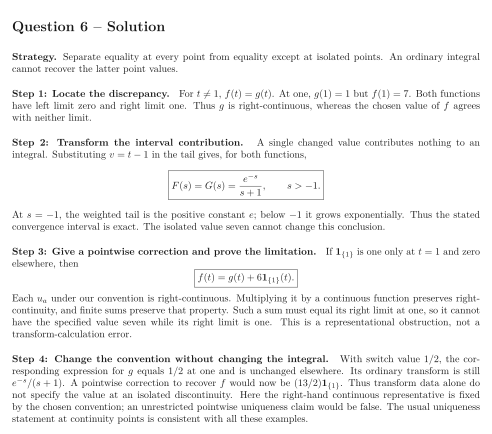
For , let for and for . Use ordinary one-sided Laplace integrals for real ; a value at one isolated point does not change an integral.
A function has a deliberately exceptional point value: Compare it with .
Tasks
Compare and pointwise, including their left and right limits at one.
Find their ordinary transforms and exact convergence intervals.
Give a pointwise formula for using and the indicator of the singleton . Explain why a finite sum of right-continuous step terms times continuous functions cannot reproduce this exceptional point value.
If a step convention instead assigns value at the switch, what changes in the formula for and what stays the same in its transform? State precisely the uniqueness conclusion justified here.
Show solutionHide solution
Question 6 – Solution
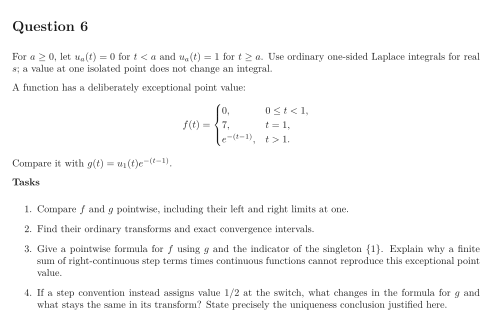
Strategy. Separate equality at every point from equality except at isolated points. An ordinary integral cannot recover the latter point values.
Step 1: Locate the discrepancy. For , . At one, but . Both functions have left limit zero and right limit one. Thus is right-continuous, whereas the chosen value of agrees with neither limit.
Step 2: Transform the interval contribution. A single changed value contributes nothing to an integral. Substituting in the tail gives, for both functions, At , the weighted tail is the positive constant ; below it grows exponentially. Thus the stated convergence interval is exact. The isolated value seven cannot change this conclusion.
Step 3: Give a pointwise correction and prove the limitation. If is one only at and zero elsewhere, then Each under our convention is right-continuous. Multiplying it by a continuous function preserves right-continuity, and finite sums preserve that property. Such a sum must equal its right limit at one, so it cannot have the specified value seven while its right limit is one. This is a representational obstruction, not a transform-calculation error.
Step 4: Change the convention without changing the integral. With switch value , the corresponding expression for equals at one and is unchanged elsewhere. Its ordinary transform is still . A pointwise correction to recover would now be . Thus transform data alone do not specify the value at an isolated discontinuity. Here the right-hand continuous representative is fixed by the chosen convention; an unrestricted pointwise uniqueness claim would be false. The usual uniqueness statement at continuity points is consistent with all these examples.