Question 7
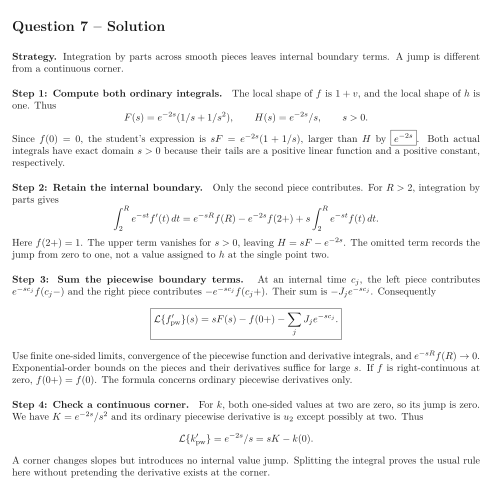
For , let for and for . Use ordinary one-sided Laplace integrals for real ; a value at one isolated point does not change an integral.
Let . Define its ordinary derivative away from the switch as for and for ; its value at two is irrelevant to integration. A student asserts .
Tasks
Calculate and directly for , and test the assertion.
Apply integration by parts separately on and to identify the missing contribution.
For a piecewise function with finitely many jumps at positive times, derive the corresponding formula for the transform of its ordinary derivative on the smooth pieces. State the needed boundary assumptions.
Apply your formula to the continuous delayed ramp . Explain why the usual derivative rule works for despite its corner.
Show solutionHide solution
Question 7 – Solution
Strategy. Integration by parts across smooth pieces leaves internal boundary terms. A jump is different from a continuous corner.
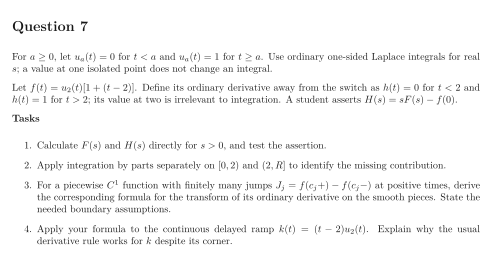
Step 1: Compute both ordinary integrals. The local shape of is , and the local shape of is one. Thus Since , the student’s expression is , larger than by . Both actual integrals have exact domain because their tails are a positive linear function and a positive constant, respectively.
Step 2: Retain the internal boundary. Only the second piece contributes. For , integration by parts gives Here . The upper term vanishes for , leaving . The omitted term records the jump from zero to one, not a value assigned to at the single point two.
Step 3: Sum the piecewise boundary terms. At an internal time , the left piece contributes and the right piece contributes . Their sum is . Consequently Use finite one-sided limits, convergence of the piecewise function and derivative integrals, and . Exponential-order bounds on the pieces and their derivatives suffice for large . If is right-continuous at zero, . The formula concerns ordinary piecewise derivatives only.
Step 4: Check a continuous corner. For , both one-sided values at two are zero, so its jump is zero. We have and its ordinary piecewise derivative is except possibly at two. Thus A corner changes slopes but introduces no internal value jump. Splitting the integral proves the usual rule here without pretending the derivative exists at the corner.