Question 5
For , let for and for . Use ordinary one-sided Laplace integrals for real ; a value at one isolated point does not change an integral.
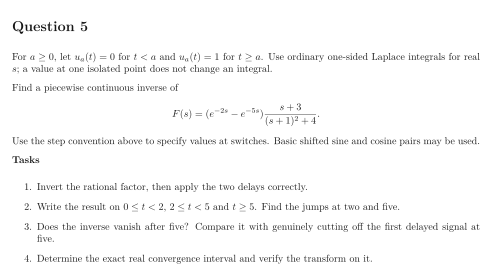
Find a piecewise continuous inverse of Use the step convention above to specify values at switches. Basic shifted sine and cosine pairs may be used.
Tasks
Invert the rational factor, then apply the two delays correctly.
Write the result on , and . Find the jumps at two and five.
Does the inverse vanish after five? Compare it with genuinely cutting off the first delayed signal at five.
Determine the exact real convergence interval and verify the transform on it.
Show solutionHide solution
Question 5 – Solution
Strategy. Subtracting a delayed copy restarts that copy’s clock. It generally does not switch off the earlier copy.
Step 1: Invert the common shape. Since , the rational factor is the transform of Thus one inverse with the stipulated endpoint convention is
Step 2: Inspect the clocks and jumps. The piecewise values are zero before two, on , and on . As , the jumps are . In particular and , while the left limit at five is .
Step 3: Distinguish subtraction from shutoff. At , , so . In fact the final piece is a nonzero exponentially decaying sinusoid, not zero. A genuinely truncated signal is instead Its shutoff term has the same global argument . To transform that term at time five, its local shape must be , not . The graph shows the actual continuing tail of .
Step 4: Verify the transform and domain. On , put . The tail is The cosine coefficient is nonzero by the preceding bound. Hence absolute convergence holds for ; at a nonzero undamped sinusoid has no convergent primitive, and below it fixed-sign lobe intervals violate the Cauchy criterion. The exact domain is . On that domain each delayed copy converges and transforms to or by substitution, proving the given expression. The truly truncated would instead converge for every real .
See the diagram in the original worksheet below.
