Question 4
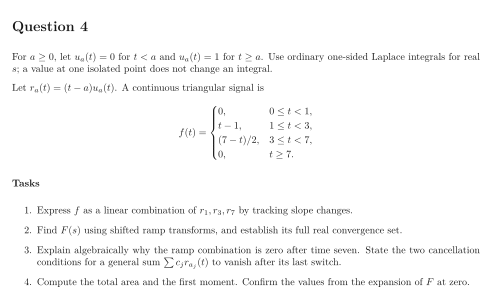
For , let for and for . Use ordinary one-sided Laplace integrals for real ; a value at one isolated point does not change an integral.
Let . A continuous triangular signal is
Tasks
Express as a linear combination of by tracking slope changes.
Find using shifted ramp transforms, and establish its full real convergence set.
Explain algebraically why the ramp combination is zero after time seven. State the two cancellation conditions for a general sum to vanish after its last switch.
Compute the total area and the first moment. Confirm the values from the expansion of at zero.
Show solutionHide solution
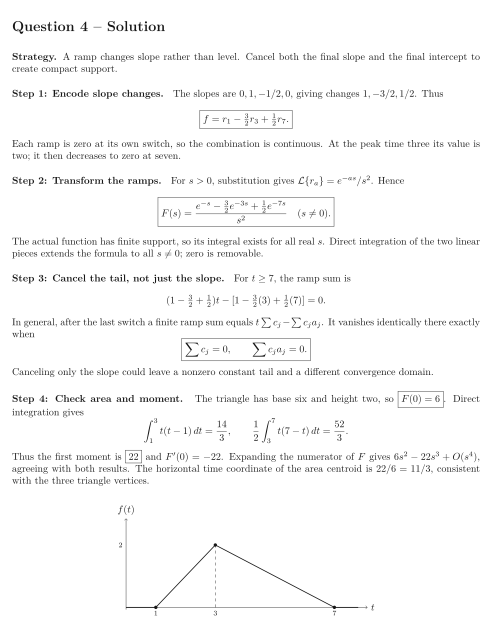
Question 4 – Solution
Strategy. A ramp changes slope rather than level. Cancel both the final slope and the final intercept to create compact support.
Step 1: Encode slope changes. The slopes are , giving changes . Thus Each ramp is zero at its own switch, so the combination is continuous. At the peak time three its value is two; it then decreases to zero at seven.
Step 2: Transform the ramps. For , substitution gives . Hence The actual function has finite support, so its integral exists for all real . Direct integration of the two linear pieces extends the formula to all ; zero is removable.
Step 3: Cancel the tail, not just the slope. For , the ramp sum is In general, after the last switch a finite ramp sum equals . It vanishes identically there exactly when Canceling only the slope could leave a nonzero constant tail and a different convergence domain.
Step 4: Check area and moment. The triangle has base six and height two, so . Direct integration gives Thus the first moment is and . Expanding the numerator of gives , agreeing with both results. The horizontal time coordinate of the area centroid is , consistent with the three triangle vertices.
See the diagram in the original worksheet below.