Question 3
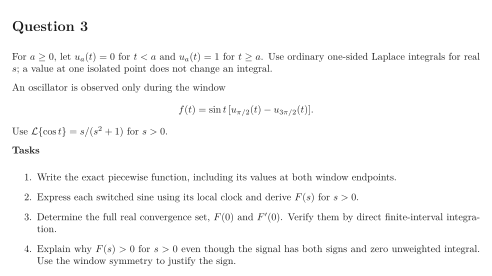
For , let for and for . Use ordinary one-sided Laplace integrals for real ; a value at one isolated point does not change an integral.
An oscillator is observed only during the window Use for .
Tasks
Write the exact piecewise function, including its values at both window endpoints.
Express each switched sine using its local clock and derive for .
Determine the full real convergence set, and . Verify them by direct finite-interval integration.
Explain why for even though the signal has both signs and zero unweighted integral. Use the window symmetry to justify the sign.
Show solutionHide solution
Question 3 – Solution
Strategy. Re-express the phase at each switch separately. The second switch occurs at a different oscillator phase.
Step 1: Identify the window and endpoint values. The function equals on and zero elsewhere. In particular , while . At the latter time the left limit is ; the graph distinguishes it from the assigned value.
Step 2: Shift the two phases correctly. With and , we have and . Therefore The plus sign in the transform reflects the phase reversal at shutoff. After , the two shifted cosine terms cancel exactly, as the original window requires.
Step 3: Use finite support to evaluate zero. The defining integral has finite support, so it converges for every real ; finite-interval integration gives the displayed expression on the whole real line. Directly, The formula also gives and expands as , verifying the derivative.
Step 4: Pair the equal and opposite lobes. Write with . Pair with . For , the earlier value is and the later value is . Their weighted contribution is Integrating these pairs proves strict positivity, despite cancellation at . This also agrees with the positive numerator and denominator of the formula for .
See the diagram in the original worksheet below.
