Question 8
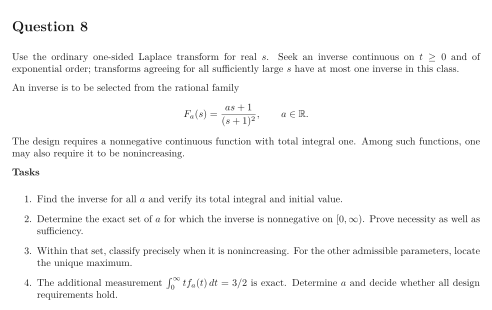
Use the ordinary one-sided Laplace transform for real . Seek an inverse continuous on and of exponential order; transforms agreeing for all sufficiently large have at most one inverse in this class.
An inverse is to be selected from the rational family The design requires a nonnegative continuous function with total integral one. Among such functions, one may also require it to be nonincreasing.
Tasks
Find the inverse for all and verify its total integral and initial value.
Determine the exact set of for which the inverse is nonnegative on . Prove necessity as well as sufficiency.
Within that set, classify precisely when it is nonincreasing. For the other admissible parameters, locate the unique maximum.
The additional measurement is exact. Determine and decide whether all design requirements hold.
Show solutionHide solution
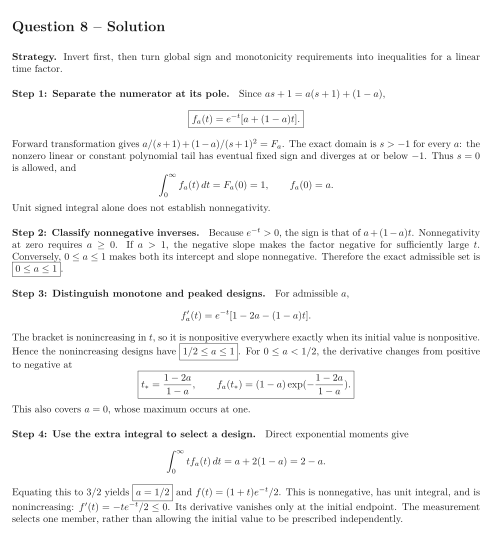
Question 8 – Solution
Strategy. Invert first, then turn global sign and monotonicity requirements into inequalities for a linear time factor.
Step 1: Separate the numerator at its pole. Since , Forward transformation gives . The exact domain is for every : the nonzero linear or constant polynomial tail has eventual fixed sign and diverges at or below . Thus is allowed, and Unit signed integral alone does not establish nonnegativity.
Step 2: Classify nonnegative inverses. Because , the sign is that of . Nonnegativity at zero requires . If , the negative slope makes the factor negative for sufficiently large . Conversely, makes both its intercept and slope nonnegative. Therefore the exact admissible set is .
Step 3: Distinguish monotone and peaked designs. For admissible , The bracket is nonincreasing in , so it is nonpositive everywhere exactly when its initial value is nonpositive. Hence the nonincreasing designs have . For , the derivative changes from positive to negative at This also covers , whose maximum occurs at one.
Step 4: Use the extra integral to select a design. Direct exponential moments give Equating this to yields and . This is nonnegative, has unit integral, and is nonincreasing: . Its derivative vanishes only at the initial endpoint. The measurement selects one member, rather than allowing the initial value to be prescribed independently.