Question 9
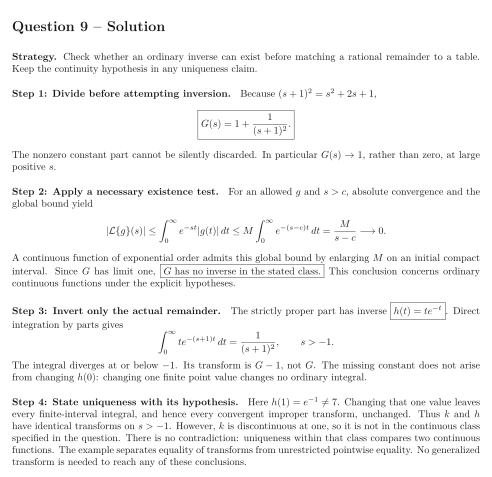
Use the ordinary one-sided Laplace transform for real . Seek an inverse continuous on and of exponential order; transforms agreeing for all sufficiently large have at most one inverse in this class.
Consider Work only with ordinary integrals and continuous functions of exponential order. You may use that such a function has a global bound on for some and real .
Tasks
Divide the polynomials to separate into its polynomial part and a strictly proper rational part.
Prove from the stated bound that every allowed ordinary transform tends to zero as . Decide whether has an inverse in the stated class.
Find the inverse of the strictly proper remainder and verify it directly. Explain why reporting as the inverse of the whole would be incorrect.
Define except that . Do and have the same ordinary transform? Explain why this does not contradict uniqueness in the stated class.
Show solutionHide solution
Question 9 – Solution
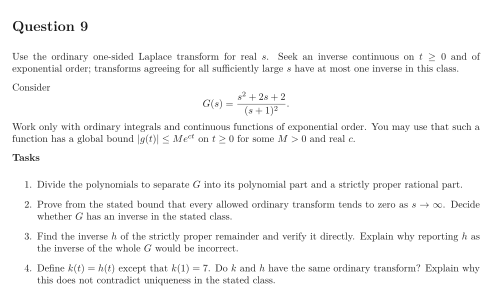
Strategy. Check whether an ordinary inverse can exist before matching a rational remainder to a table. Keep the continuity hypothesis in any uniqueness claim.
Step 1: Divide before attempting inversion. Because , The nonzero constant part cannot be silently discarded. In particular , rather than zero, at large positive .
Step 2: Apply a necessary existence test. For an allowed and , absolute convergence and the global bound yield A continuous function of exponential order admits this global bound by enlarging on an initial compact interval. Since has limit one, This conclusion concerns ordinary continuous functions under the explicit hypotheses.
Step 3: Invert only the actual remainder. The strictly proper part has inverse . Direct integration by parts gives The integral diverges at or below . Its transform is , not . The missing constant does not arise from changing : changing one finite point value changes no ordinary integral.
Step 4: State uniqueness with its hypothesis. Here . Changing that one value leaves every finite-interval integral, and hence every convergent improper transform, unchanged. Thus and have identical transforms on . However, is discontinuous at one, so it is not in the continuous class specified in the question. There is no contradiction: uniqueness within that class compares two continuous functions. The example separates equality of transforms from unrestricted pointwise equality. No generalized transform is needed to reach any of these conclusions.