Question 7
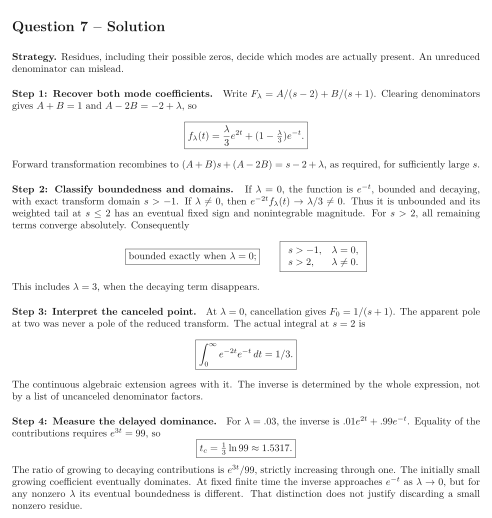
Use the ordinary one-sided Laplace transform for real . Seek an inverse continuous on and of exponential order; transforms agreeing for all sufficiently large have at most one inverse in this class.
A parameter-dependent expression is When a factor cancels, interpret its algebraic value at the canceled point by continuous extension.
Tasks
Find the inverse for every real and verify its transform.
Determine exactly which parameter values give a bounded inverse. State the full real convergence domain in every case.
Explain why the printed factor alone does not establish a growing mode when . What transform value exists at in that case?
For , find the time at which the growing and decaying contributions are equal. Explain how a small coefficient can change the eventual behavior.
Show solutionHide solution
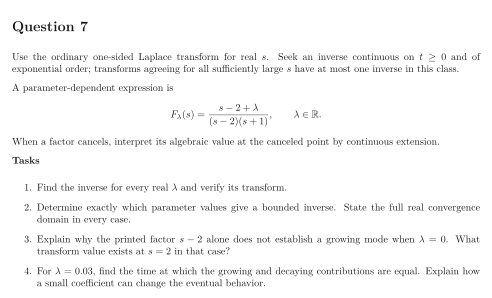
Question 7 – Solution
Strategy. Residues, including their possible zeros, decide which modes are actually present. An unreduced denominator can mislead.
Step 1: Recover both mode coefficients. Write . Clearing denominators gives and , so Forward transformation recombines to , as required, for sufficiently large .
Step 2: Classify boundedness and domains. If , the function is , bounded and decaying, with exact transform domain . If , then . Thus it is unbounded and its weighted tail at has an eventual fixed sign and nonintegrable magnitude. For , all remaining terms converge absolutely. Consequently This includes , when the decaying term disappears.
Step 3: Interpret the canceled point. At , cancellation gives . The apparent pole at two was never a pole of the reduced transform. The actual integral at is The continuous algebraic extension agrees with it. The inverse is determined by the whole expression, not by a list of uncanceled denominator factors.
Step 4: Measure the delayed dominance. For , the inverse is . Equality of the contributions requires , so The ratio of growing to decaying contributions is , strictly increasing through one. The initially small growing coefficient eventually dominates. At fixed finite time the inverse approaches as , but for any nonzero its eventual boundedness is different. That distinction does not justify discarding a small nonzero residue.