Question 6
Let and . Consider on . For , seek a particular response and define its amplitude . At , define as the absolute value of the constant particular response.
Tasks
Derive for and find the constant response at zero frequency.
Find the frequency maximizing on and the maximum amplitude.
At , describe the phase of the response relative to the forcing and compare its amplitude with the maximum.
For , prove that this is the unique -periodic solution and that every other solution approaches it as .
Show solutionHide solution
Question 6 – Solution
Strategy. Solve the two coefficient equations, then minimize the amplitude denominator instead of differentiating a complicated square root.
Step 1: Match the harmonic components. The equations are Writing , we obtain At , use the constant particular solution .
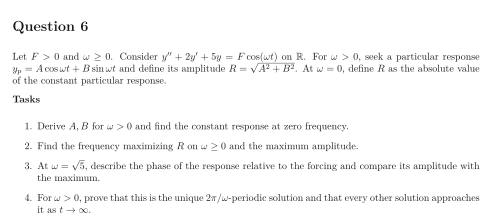
Step 2: Maximize the amplitude. For all , including this constant-response convention, The denominator is minimized exactly at , giving .
Step 3: Locate the quarter-cycle phase lag. At , and , so . This is a cosine delayed by phase . Its amplitude is smaller than ; the quarter-cycle phase frequency is not the amplitude-maximizing frequency.
Step 4: Prove the steady response is unique. Every difference from is and tends to zero forward. If a second solution had the same period , this difference would be periodic too. For any fixed , its value equals its value at , whose limit is zero. Hence the difference is identically zero, proving uniqueness of the periodic response.
See the diagram in the original worksheet below.