Question 5
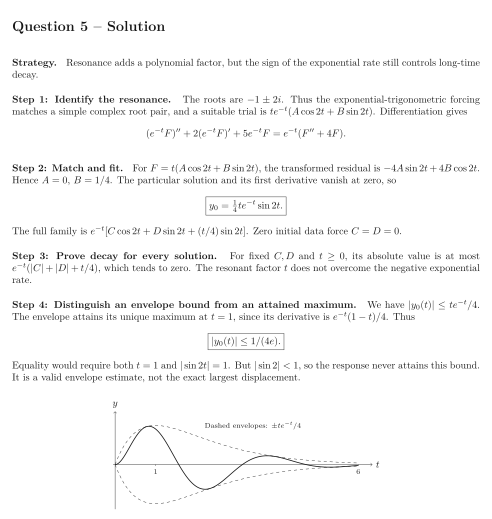
For , consider
Tasks
Find the homogeneous roots and choose a correct resonant trial. Derive a useful operator identity with .
Determine the particular solution and the complete zero-data response.
Despite the resonance, prove that every solution tends to zero as .
Find a simple envelope for the zero-data response and prove the bound for . Is equality actually attained by the response?
Show solutionHide solution
Question 5 – Solution
Strategy. Resonance adds a polynomial factor, but the sign of the exponential rate still controls long-time decay.
Step 1: Identify the resonance. The roots are . Thus the exponential-trigonometric forcing matches a simple complex root pair, and a suitable trial is . Differentiation gives
Step 2: Match and fit. For , the transformed residual is . Hence , . The particular solution and its first derivative vanish at zero, so The full family is . Zero initial data force .
Step 3: Prove decay for every solution. For fixed and , its absolute value is at most , which tends to zero. The resonant factor does not overcome the negative exponential rate.
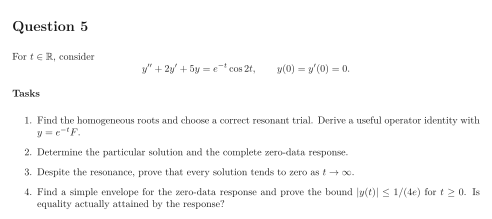
Step 4: Distinguish an envelope bound from an attained maximum. We have . The envelope attains its unique maximum at , since its derivative is . Thus Equality would require both and . But , so the response never attains this bound. It is a valid envelope estimate, not the exact largest displacement.
See the diagram in the original worksheet below.