Question 7
For , let solve
Tasks
Use undetermined coefficients to find for , including the homogeneous correction.
At , choose a resonant trial and solve the same initial-value problem directly.
For every fixed , compute . Explain why the divergent particular coefficient for does not imply a divergent fixed-time limit of the full response.
Compare boundedness on in the resonant and nonresonant cases. Can the convergence as be uniform on that entire half-line?
Show solutionHide solution
Question 7 – Solution
Strategy. Fit the initial data before taking the frequency limit; the homogeneous correction cancels the divergent constant part.
Step 1: Solve off resonance. The trial gives . Fitting zero data adds , so Both the value and slope at zero vanish.
Step 2: Solve at resonance. Use . Applying gives , hence , . Its data are already zero, so .
Step 3: Take the fixed-time limit. Differentiating numerator and denominator with respect to gives This includes . The particular coefficient and the cosine correction separately diverge, but their full numerator vanishes at the same rate as the denominator. They must be combined before taking the limit.
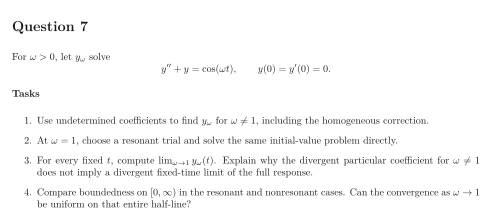
Step 4: Compare long-time behavior. For fixed , on the whole half-line. The resonant response is unbounded, for example at . Consequently, for each fixed nonresonant , the difference is unbounded on that half-line. Uniform convergence there is impossible, although the fixed-time limit exists. A finite-window plot cannot replace this distinction.
See the diagram in the original worksheet below.