Question 4
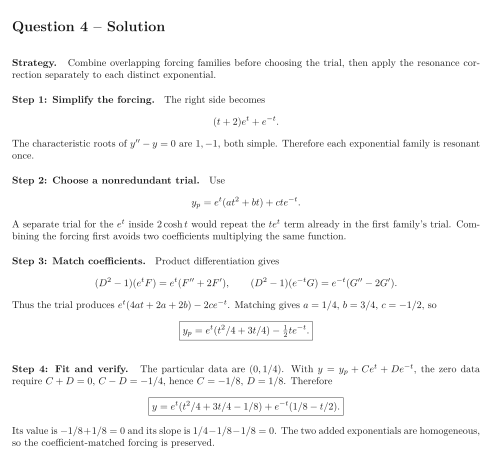
On , solve where .
Tasks
Rewrite the forcing into distinct exponential families and identify every resonant component.
Choose one combined trial with no duplicate unknown coefficients. Explain why matching separate overlapping trials would introduce redundancy.
Determine a particular solution by coefficient matching.
Add the homogeneous correction, solve the initial-value problem, and verify both the equation and initial data.
Show solutionHide solution
Question 4 – Solution
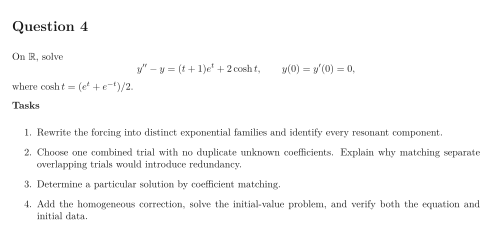
Strategy. Combine overlapping forcing families before choosing the trial, then apply the resonance correction separately to each distinct exponential.
Step 1: Simplify the forcing. The right side becomes The characteristic roots of are , both simple. Therefore each exponential family is resonant once.
Step 2: Choose a nonredundant trial. Use A separate trial for the inside would repeat the term already in the first family’s trial. Combining the forcing first avoids two coefficients multiplying the same function.
Step 3: Match coefficients. Product differentiation gives Thus the trial produces . Matching gives , , , so
Step 4: Fit and verify. The particular data are . With , the zero data require , , hence , . Therefore Its value is and its slope is . The two added exponentials are homogeneous, so the coefficient-matched forcing is preserved.