Question 5
For on , a proposed particular solution is . Prescribe real initial data , .
Tasks
Verify the particular solution and find the full initial-value solution in terms of .
Find a necessary and sufficient relation between for boundedness on . For those data, determine the limiting difference .
Find the unique solution bounded on all of . Does the selected bounded solution necessarily have a limit as ?
Compare the trajectories from and . Explain why bounded forcing alone does not make every solution bounded.
Show solutionHide solution
Question 5 – Solution
Strategy. The difference from a particular solution follows the homogeneous equation, whose growing mode determines boundedness.
Step 1: Verify and fit. Since , . The general solution is . The data give , , hence
Step 2: Eliminate the growing mode. The bounded oscillatory and decaying terms cannot cancel a nonzero as . Thus forward boundedness holds exactly when In that case , so . This convergence is to a time-varying particular solution, not necessarily to a constant.
Step 3: Require both time directions. Boundedness as also forces . Thus the unique globally bounded solution is , with data . It has no limit at positive infinity: its values at and are and . The forward-bounded family also has these two limiting subsequences because its decaying correction tends to zero.
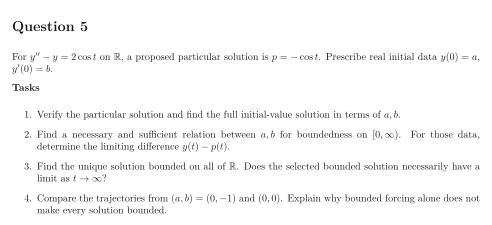
Step 4: Compare the selected data. Data give , which is bounded forward. Data give , which is unbounded forward. Both have the same bounded forcing; the second retains a growing homogeneous component. The finite plot illustrates the distinction; the mode argument proves the global claim.
See the diagram in the original worksheet below.