Question 6
For on , a proposed particular solution is . The forcing is bounded in absolute value by one.
Tasks
Verify the particular solution and find the full solution family.
Solve the initial-value problem with arbitrary data , . Identify the zero-data response.
Prove that every solution is unbounded above and below on , using two explicit sequences of times. Can a homogeneous correction remove this behavior?
For the zero-data response, give exact upper and lower envelope bounds on and the times when they are attained. Explain why envelope contacts need not be stationary points.
Show solutionHide solution
Question 6 – Solution
Strategy. Verify the supplied growing response and use exact phase samples to rule out cancellation by bounded homogeneous terms.
Step 1: Verify and complete. Differentiation gives Thus and the general solution is
Step 2: Fit the data. Since , the data give , . In particular the zero-data response is exactly .
Step 3: Prove both unbounded excursions. At , , we have . At , we have . These values do not depend on . Thus no constant homogeneous correction removes the unbounded behavior, even though the forcing is bounded.
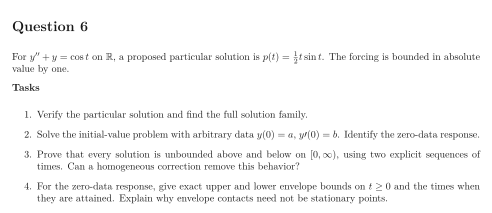
Step 4: Distinguish bounds from extrema. On , For , the upper envelope is attained exactly at and the lower at ; both bounds also coincide with at zero. At a positive upper contact , and at a lower contact . These slopes match those of the respective envelopes and are not zero, so the contacts are not stationary points of .
See the diagram in the original worksheet below.