Question 4
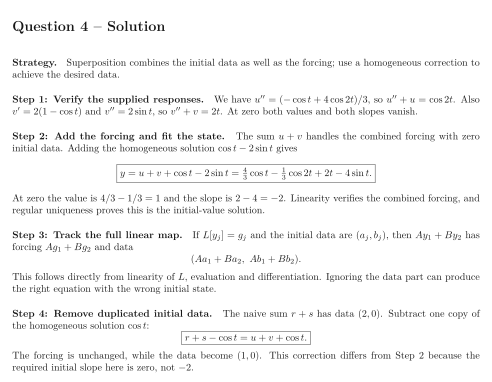
For the operator , consider the supplied responses on .
Tasks
Verify that , , and that both responses have zero value and slope at zero.
Construct the solution of with , . Verify the data.
State and prove how both forcing and initial data combine when a constant linear combination of two responses is formed.
Let and . Each now has data . Correct the naive sum so that it has the combined forcing but only the single prescribed data pair .
Show solutionHide solution
Question 4 – Solution
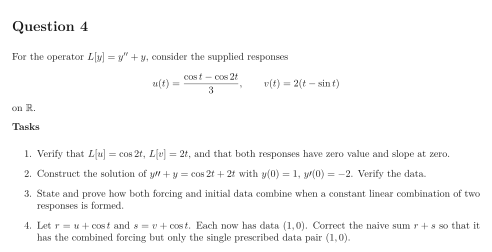
Strategy. Superposition combines the initial data as well as the forcing; use a homogeneous correction to achieve the desired data.
Step 1: Verify the supplied responses. We have , so . Also and , so . At zero both values and both slopes vanish.
Step 2: Add the forcing and fit the state. The sum handles the combined forcing with zero initial data. Adding the homogeneous solution gives At zero the value is and the slope is . Linearity verifies the combined forcing, and regular uniqueness proves this is the initial-value solution.
Step 3: Track the full linear map. If and the initial data are , then has forcing and data This follows directly from linearity of , evaluation and differentiation. Ignoring the data part can produce the right equation with the wrong initial state.
Step 4: Remove duplicated initial data. The naive sum has data . Subtract one copy of the homogeneous solution : The forcing is unchanged, while the data become . This correction differs from Step 2 because the required initial slope here is zero, not .