Question 3
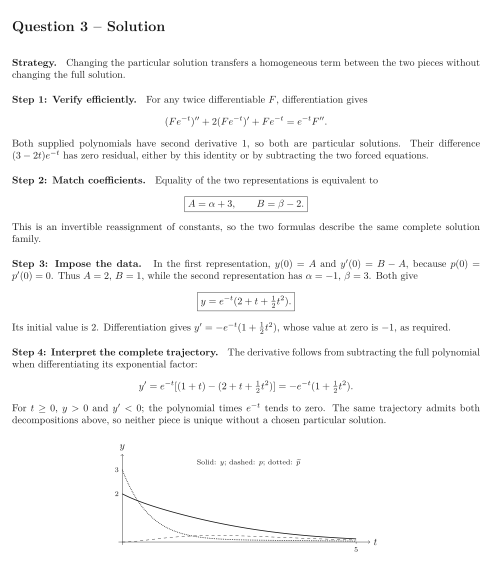
For on , two proposed particular solutions are Two solvers write and .
Tasks
Verify both particular solutions and explain why their difference must be homogeneous.
Derive the exact relation between the two pairs of homogeneous constants. Do the two formulas describe different solution sets?
Solve , in both representations and verify the data.
For the selected solution on , determine positivity, monotonicity and its limit. Explain why the particular and homogeneous pieces are not uniquely determined by the trajectory.
Show solutionHide solution
Question 3 – Solution
Strategy. Changing the particular solution transfers a homogeneous term between the two pieces without changing the full solution.
Step 1: Verify efficiently. For any twice differentiable , differentiation gives Both supplied polynomials have second derivative , so both are particular solutions. Their difference has zero residual, either by this identity or by subtracting the two forced equations.
Step 2: Match coefficients. Equality of the two representations is equivalent to This is an invertible reassignment of constants, so the two formulas describe the same complete solution family.
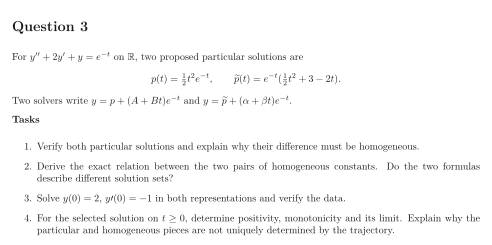
Step 3: Impose the data. In the first representation, and , because . Thus , , while the second representation has , . Both give Its initial value is . Differentiation gives , whose value at zero is , as required.
Step 4: Interpret the complete trajectory. The derivative follows from subtracting the full polynomial when differentiating its exponential factor: For , and ; the polynomial times tends to zero. The same trajectory admits both decompositions above, so neither piece is unique without a chosen particular solution.
See the diagram in the original worksheet below.