Question 6
Consider homogeneous constant-coefficient equations with two distinct real roots and endpoint data , , where .
Tasks
Prove that every pair determines exactly one solution by solving for the two mode coefficients. Identify the quantity that cannot vanish.
Solve with .
Prove that a nonzero combination has at most one real zero. Treat vanishing coefficients explicitly, and deduce positivity between strictly positive endpoints.
For the solution in Task 2, find its maximum on and sketch it. Does positivity between positive endpoints mean the solution stays below its endpoint values?
Show solutionHide solution
Question 6 – Solution
Strategy. Use the strict inequality of real exponentials to solve the endpoint problem and control the number of zeros.
Step 1: Invert the endpoint constraints. For , the conditions give and . Therefore Because and , the denominator is strictly positive. There is exactly one coefficient pair for all endpoint data, unlike some oscillatory endpoint problems.
Step 2: Fit the concrete equation. Here the roots are 1 and 2. At , the equations are and . Hence Both endpoints have value 1, and each mode satisfies the original equation.
Step 3: Bound the number of zeros and deduce positivity. Factor the general solution as . If , the bracket is strictly monotone, so it has at most one zero. If , a nonzero solution is a nonvanishing pure exponential; the case is likewise nonvanishing.
If a solution with positive endpoints became negative inside, continuity would force two distinct zeros. If it merely touched zero inside while staying nonnegative, that interior minimum would have ; initial-value uniqueness would force the identically zero solution, contradicting the endpoints. Thus it is strictly positive throughout the interval.
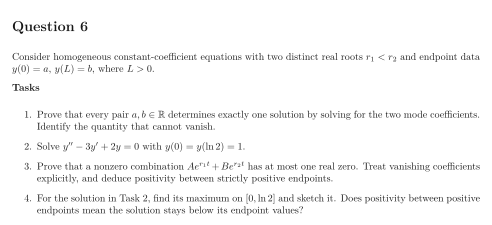
See the diagram in the original worksheet below.
Step 4: Distinguish positivity from an upper bound. For the concrete solution, changes from positive to negative at , which lies between 0 and . Its value there is The curve stays positive but exceeds both endpoint values. A restriction on zeros is not a maximum principle bounding the response by its endpoints.