Question 5
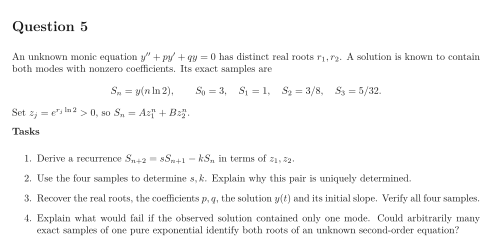
An unknown monic equation has distinct real roots . A solution is known to contain both modes with nonzero coefficients. Its exact samples are Set , so .
Tasks
Derive a recurrence in terms of .
Use the four samples to determine . Explain why this pair is uniquely determined.
Recover the real roots, the coefficients , the solution and its initial slope. Verify all four samples.
Explain what would fail if the observed solution contained only one mode. Could arbitrarily many exact samples of one pure exponential identify both roots of an unknown second-order equation?
Show solutionHide solution
Question 5 – Solution
Strategy. Recover the two exponential multipliers from a sample recurrence, then convert those multipliers back into differential-equation roots.
Step 1: Derive the recurrence. Each satisfies . Multiplying by its mode coefficient and , then summing, gives
Step 2: Solve the sample equations exactly. For , Substitution of into the second equation gives . Hence The nonzero coefficient in this elimination proves uniqueness. Equivalently, .
Step 3: Recover and verify the continuous model. The multipliers solve . Since , the roots are . Thus , .
Writing , the first two samples give , , so , . Therefore The four sample values are , , , and , as required. Both coefficients are nonzero.
Step 4: Identify the missing-information case. For a pure observed mode , the recurrence only imposes . Any positive second multiplier different from gives another pair with exactly the same samples. Thus the active root can be identified, but an unexcited root remains undetermined, even with arbitrarily many noiseless samples of that one trajectory. Exact data do not reveal a mode whose coefficient is zero.