Question 7
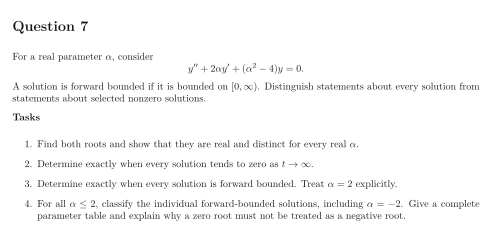
For a real parameter , consider A solution is forward bounded if it is bounded on . Distinguish statements about every solution from statements about selected nonzero solutions.
Tasks
Find both roots and show that they are real and distinct for every real .
Determine exactly when every solution tends to zero as .
Determine exactly when every solution is forward bounded. Treat explicitly.
For all , classify the individual forward-bounded solutions, including . Give a complete parameter table and explain why a zero root must not be treated as a negative root.
Show solutionHide solution
Question 7 – Solution
Strategy. Track the two root signs and retain the distinction between a mode being available and its coefficient actually being present.
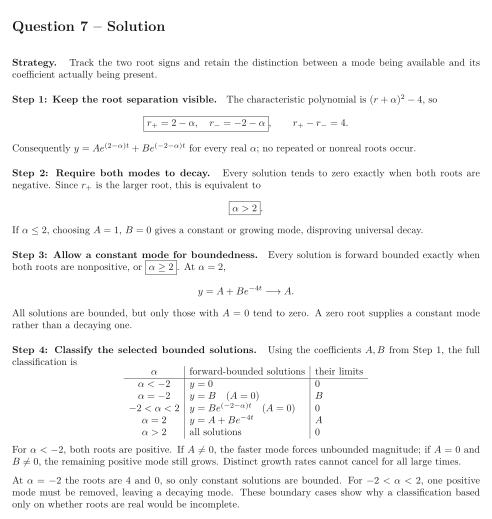
Step 1: Keep the root separation visible. The characteristic polynomial is , so Consequently for every real ; no repeated or nonreal roots occur.
Step 2: Require both modes to decay. Every solution tends to zero exactly when both roots are negative. Since is the larger root, this is equivalent to If , choosing , gives a constant or growing mode, disproving universal decay.
Step 3: Allow a constant mode for boundedness. Every solution is forward bounded exactly when both roots are nonpositive, or . At , All solutions are bounded, but only those with tend to zero. A zero root supplies a constant mode rather than a decaying one.
Step 4: Classify the selected bounded solutions. Using the coefficients from Step 1, the full classification is For , both roots are positive. If , the faster mode forces unbounded magnitude; if and , the remaining positive mode still grows. Distinct growth rates cannot cancel for all large times.
At the roots are 4 and 0, so only constant solutions are bounded. For , one positive mode must be removed, leaving a decaying mode. These boundary cases show why a classification based only on whether roots are real would be incomplete.