Question 6
Let and let be continuous on . Consider Use the homogeneous basis .
Tasks
Derive a single definite-integral formula for the response by variation of parameters, and verify it by differentiation.
If with , find a sharp bound for on and exhibit forcing that attains it.
If , prove and give a precise condition guaranteeing at a specified time .
For , find an elementary response and compare it with the bound for .
Show solutionHide solution
Question 6 – Solution
Strategy. The sign of the integral kernel gives comparison and error bounds without evaluating each forcing integral.
Step 1: Derive the response kernel. Here , so and . Integrating from zero and combining gives Differentiation gives and . Both initial data vanish.
Step 2: Prove sharpness. For , . Consequently Constant forcing gives equality for every , and gives equality in magnitude. The bound is therefore sharp for this forcing class; it also bounds response error when denotes a forcing error.
Step 3: Prove positivity carefully. If , the integral is nonnegative. At fixed , it is strictly positive exactly when is not identically zero on . Indeed, continuity then gives a positive subinterval lying before , where the kernel is strictly positive. Forcing that is positive only at later times cannot make the response positive at this time.
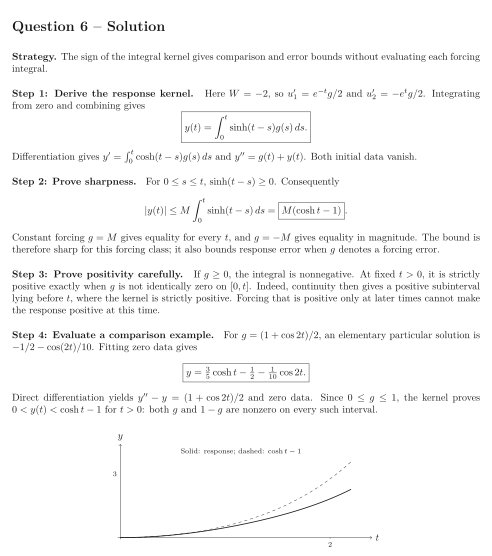
Step 4: Evaluate a comparison example. For , an elementary particular solution is . Fitting zero data gives Direct differentiation yields and zero data. Since , the kernel proves for : both and are nonzero on every such interval.
See the diagram in the original worksheet below.