Question 5
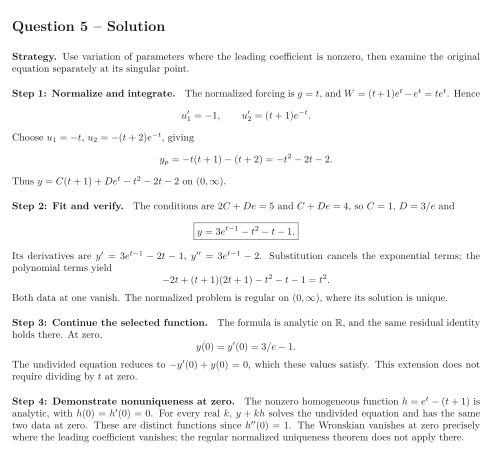
On , solve The functions and solve the homogeneous equation. Also consider the original undivided equation at .
Tasks
Normalize the equation, compute the Wronskian, and obtain a particular solution by variation of parameters.
Fit the initial data and check the result directly in the undivided equation.
Does this selected function extend smoothly through zero and still satisfy the undivided equation? Find its value and slope there.
Prove that these same value and slope at zero do not select a unique smooth solution of the undivided equation near zero.
Show solutionHide solution
Question 5 – Solution
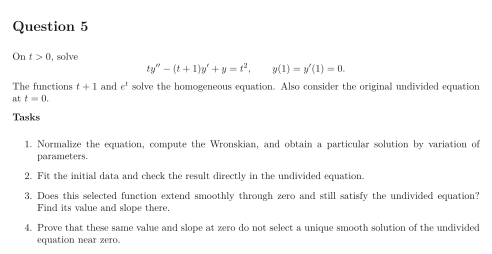
Strategy. Use variation of parameters where the leading coefficient is nonzero, then examine the original equation separately at its singular point.
Step 1: Normalize and integrate. The normalized forcing is , and . Hence Choose , , giving Thus on .
Step 2: Fit and verify. The conditions are and , so , and Its derivatives are , . Substitution cancels the exponential terms; the polynomial terms yield Both data at one vanish. The normalized problem is regular on , where its solution is unique.
Step 3: Continue the selected function. The formula is analytic on , and the same residual identity holds there. At zero, The undivided equation reduces to , which these values satisfy. This extension does not require dividing by at zero.
Step 4: Demonstrate nonuniqueness at zero. The nonzero homogeneous function is analytic, with . For every real , solves the undivided equation and has the same two data at zero. These are distinct functions since . The Wronskian vanishes at zero precisely where the leading coefficient vanishes; the regular normalized uniqueness theorem does not apply there.