Question 2
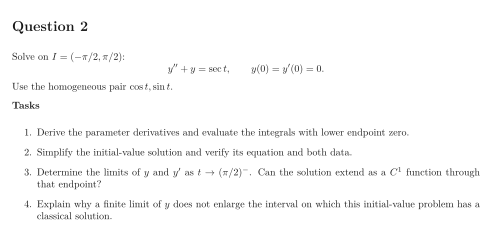
Solve on : Use the homogeneous pair .
Tasks
Derive the parameter derivatives and evaluate the integrals with lower endpoint zero.
Simplify the initial-value solution and verify its equation and both data.
Determine the limits of and as . Can the solution extend as a function through that endpoint?
Explain why a finite limit of does not enlarge the interval on which this initial-value problem has a classical solution.
Show solutionHide solution
Question 2 – Solution
Strategy. The forcing is singular at the interval endpoints. Keep its domain visible even when the solution itself has a finite limit.
Step 1: Integrate the parameter system. Here . The equations and give Since on , integration from zero yields , .
Step 2: Verify the response. The zero lower endpoints fit both data, and Differentiation simplifies to Therefore , and both data vanish.
Step 3: Examine the endpoint. Using as , we obtain Thus even a extension is impossible. The graph approaches a finite height with an unbounded positive slope; the endpoint is excluded.
Step 4: Keep the equation’s domain. The right side is undefined at and . A continuous assignment to at an endpoint would not define the differential equation there. The maximal open interval containing zero on which this IVP is classical is exactly .
See the diagram in the original worksheet below.
