Question 1
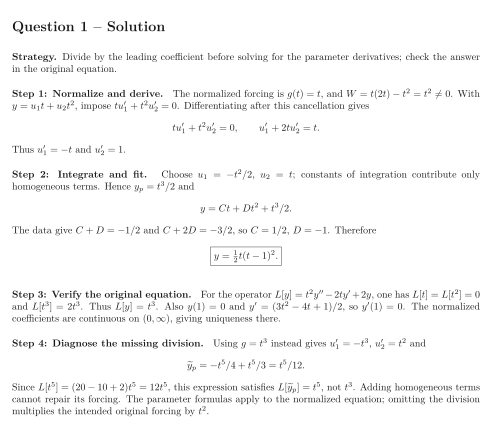
On , consider Two homogeneous solutions are and .
Tasks
Normalize the equation and compute the Wronskian. Derive the two equations for the parameter derivatives using the auxiliary condition .
Use variation of parameters to find a particular solution and then fit the initial data.
Check the final solution in the original, unnormalized equation and at the initial point.
A student inserts , rather than the normalized forcing, into the parameter formulas. Find the resulting particular expression and its actual forcing in the original equation. Explain the error.
Show solutionHide solution
Question 1 – Solution
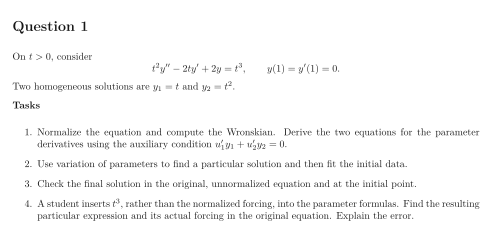
Strategy. Divide by the leading coefficient before solving for the parameter derivatives; check the answer in the original equation.
Step 1: Normalize and derive. The normalized forcing is , and . With , impose . Differentiating after this cancellation gives Thus and .
Step 2: Integrate and fit. Choose , ; constants of integration contribute only homogeneous terms. Hence and The data give and , so , . Therefore
Step 3: Verify the original equation. For the operator , one has and . Thus . Also and , so . The normalized coefficients are continuous on , giving uniqueness there.
Step 4: Diagnose the missing division. Using instead gives , and Since , this expression satisfies , not . Adding homogeneous terms cannot repair its forcing. The parameter formulas apply to the normalized equation; omitting the division multiplies the intended original forcing by .