Question 7
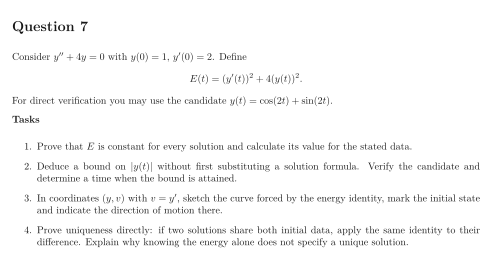
Consider with , . Define For direct verification you may use the candidate .
Tasks
Prove that is constant for every solution and calculate its value for the stated data.
Deduce a bound on without first substituting a solution formula. Verify the candidate and determine a time when the bound is attained.
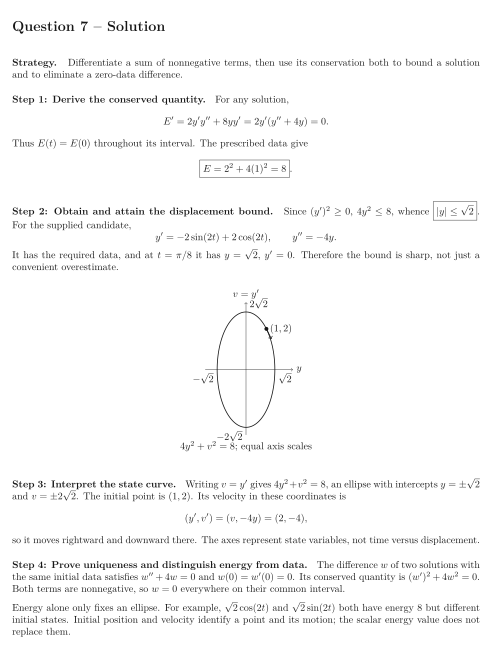
In coordinates with , sketch the curve forced by the energy identity, mark the initial state and indicate the direction of motion there.
Prove uniqueness directly: if two solutions share both initial data, apply the same identity to their difference. Explain why knowing the energy alone does not specify a unique solution.
Show solutionHide solution
Question 7 – Solution
Strategy. Differentiate a sum of nonnegative terms, then use its conservation both to bound a solution and to eliminate a zero-data difference.
Step 1: Derive the conserved quantity. For any solution, Thus throughout its interval. The prescribed data give
Step 2: Obtain and attain the displacement bound. Since , , whence . For the supplied candidate, It has the required data, and at it has , . Therefore the bound is sharp, not just a convenient overestimate.
See the diagram in the original worksheet below.
Step 3: Interpret the state curve. Writing gives , an ellipse with intercepts and . The initial point is . Its velocity in these coordinates is so it moves rightward and downward there. The axes represent state variables, not time versus displacement.
Step 4: Prove uniqueness and distinguish energy from data. The difference of two solutions with the same initial data satisfies and . Its conserved quantity is . Both terms are nonnegative, so everywhere on their common interval.
Energy alone only fixes an ellipse. For example, and both have energy 8 but different initial states. Initial position and velocity identify a point and its motion; the scalar energy value does not replace them.