Question 8
Suppose both and solve an unknown normalized homogeneous equation on .
Tasks
Determine and directly from the two supplied solutions. Check your result by substitution.
Can any normalized equation of this form, with continuous on an interval containing zero, have both supplied functions as solutions there? Prove your answer without a determinant formula.
Multiply the equation from Task 1 by . Show that the undivided equation admits on all of . Determine all members of this family satisfying , .
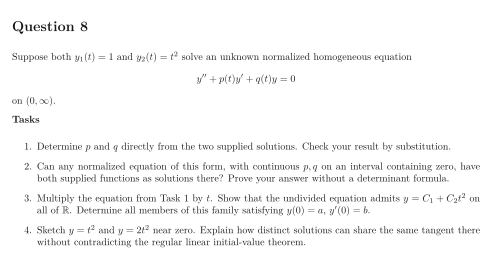
Sketch and near zero. Explain how distinct solutions can share the same tangent there without contradicting the regular linear initial-value theorem.
Show solutionHide solution
Question 8 – Solution
Strategy. Insert simple known solutions to recover coefficients, then inspect what changes when the leading coefficient vanishes.
Step 1: Recover the equation on its stated interval. Inserting gives . Inserting then gives , so The constant solution has both derivatives zero, and verifies the quadratic solution.
Step 2: Rule out a regular equation through zero. At , the function has value 0, first derivative 0 and second derivative 2. In any normalized equation with finite coefficients at zero it would require which is impossible. Thus no continuous-coefficient normalized equation on an interval containing zero can have both supplied functions as solutions. The obstruction is already visible from the quadratic alone.
Step 3: Retain the degenerate leading coefficient. The undivided equation is . For , its left-hand side is , including at zero. The family has , , so Indeed, the undivided equation itself at zero forces , so nonzero permits no solution at all.
See the diagram in the original worksheet below.
Step 4: Explain the shared tangent. The two plotted functions share value 0 and slope 0 at zero but have different curvatures. The coefficient of vanishes there, so the equation does not determine the second derivative from those data. Its normalized coefficient is not continuous at the initial point. The regular linear theorem therefore does not apply, and the multiple zero-data solutions do not contradict it.