Question 6
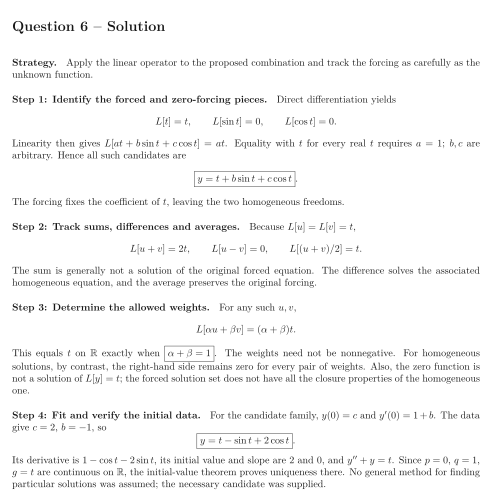
Let and consider the forced equation . The functions , and are supplied for direct verification.
Tasks
Compute , and . Determine exactly which constants make solve the forced equation on .
Let and . Determine the equations satisfied by , and .
For arbitrary solutions of , determine exactly which real weights ensure is again a solution. Explain the difference from homogeneous superposition.
Find a solution with , . Verify it and justify uniqueness using the continuous-coefficient initial-value theorem.
Show solutionHide solution
Question 6 – Solution
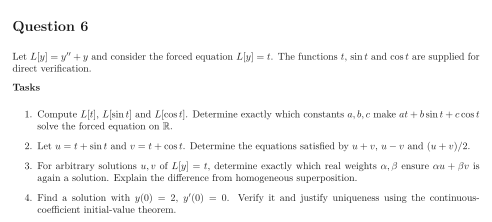
Strategy. Apply the linear operator to the proposed combination and track the forcing as carefully as the unknown function.
Step 1: Identify the forced and zero-forcing pieces. Direct differentiation yields Linearity then gives . Equality with for every real requires ; are arbitrary. Hence all such candidates are The forcing fixes the coefficient of , leaving the two homogeneous freedoms.
Step 2: Track sums, differences and averages. Because , The sum is generally not a solution of the original forced equation. The difference solves the associated homogeneous equation, and the average preserves the original forcing.
Step 3: Determine the allowed weights. For any such , This equals on exactly when . The weights need not be nonnegative. For homogeneous solutions, by contrast, the right-hand side remains zero for every pair of weights. Also, the zero function is not a solution of ; the forced solution set does not have all the closure properties of the homogeneous one.
Step 4: Fit and verify the initial data. For the candidate family, and . The data give , , so Its derivative is , its initial value and slope are 2 and 0, and . Since , , are continuous on , the initial-value theorem proves uniqueness there. No general method for finding particular solutions was assumed; the necessary candidate was supplied.