Question 5
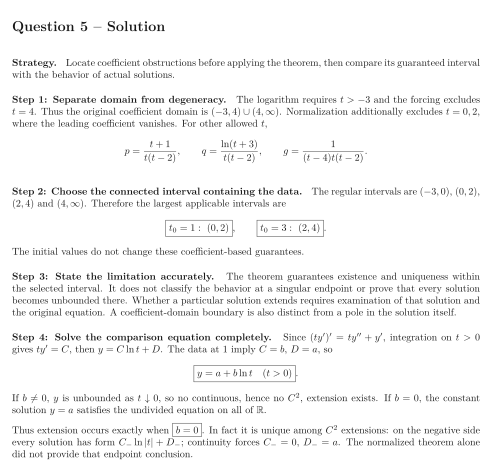
For a normalized linear equation , continuity of on an open interval containing the initial time guarantees a unique solution throughout that interval for any two initial data.
Consider All functions and solutions are real.
Tasks
Find the domain of the displayed coefficients before normalization. List the additional points excluded when solving for .
Find the largest theorem-guaranteed interval for initial time , and then for , with arbitrary finite initial value and slope.
Does a finite endpoint of such an interval prove that every solution blows up there? Explain precisely what the theorem does and does not say.
Test that distinction on the separate equation with data , . Solve on and determine exactly which resulting solutions extend as solutions of the undivided equation across zero.
Show solutionHide solution
Question 5 – Solution
Strategy. Locate coefficient obstructions before applying the theorem, then compare its guaranteed interval with the behavior of actual solutions.
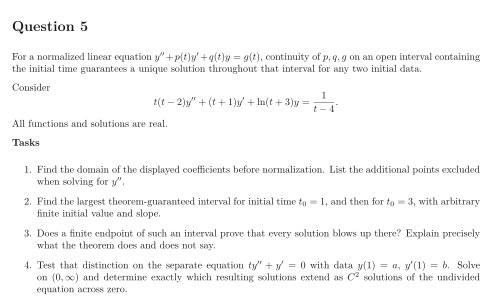
Step 1: Separate domain from degeneracy. The logarithm requires and the forcing excludes . Thus the original coefficient domain is . Normalization additionally excludes , where the leading coefficient vanishes. For other allowed ,
Step 2: Choose the connected interval containing the data. The regular intervals are , , and . Therefore the largest applicable intervals are The initial values do not change these coefficient-based guarantees.
Step 3: State the limitation accurately. The theorem guarantees existence and uniqueness within the selected interval. It does not classify the behavior at a singular endpoint or prove that every solution becomes unbounded there. Whether a particular solution extends requires examination of that solution and the original equation. A coefficient-domain boundary is also distinct from a pole in the solution itself.
Step 4: Solve the comparison equation completely. Since , integration on gives , then . The data at 1 imply , , so If , is unbounded as , so no continuous, hence no , extension exists. If , the constant solution satisfies the undivided equation on all of .
Thus extension occurs exactly when . In fact it is unique among extensions: on the negative side every solution has form ; continuity forces , . The normalized theorem alone did not provide that endpoint conclusion.