Question 5
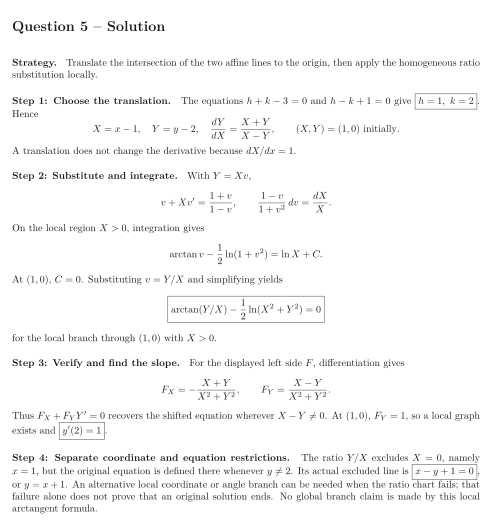
Consider on the domain .
Tasks
Find constants such that , remove the constant terms in both affine expressions. Write the shifted equation and initial point.
On a neighborhood of that point with , use to obtain an implicit solution in .
Verify the local implicit relation and find the slope at the original initial point.
Is automatically a singular line of the original differential equation? Identify the actual excluded line and explain the difference between these restrictions.
Show solutionHide solution
Question 5 – Solution
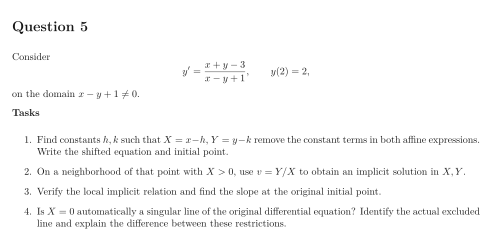
Strategy. Translate the intersection of the two affine lines to the origin, then apply the homogeneous ratio substitution locally.
Step 1: Choose the translation. The equations and give . Hence A translation does not change the derivative because .
Step 2: Substitute and integrate. With , On the local region , integration gives At , . Substituting and simplifying yields for the local branch through with .
Step 3: Verify and find the slope. For the displayed left side , differentiation gives Thus recovers the shifted equation wherever . At , , so a local graph exists and .
Step 4: Separate coordinate and equation restrictions. The ratio excludes , namely , but the original equation is defined there whenever . Its actual excluded line is , or . An alternative local coordinate or angle branch can be needed when the ratio chart fails; that failure alone does not prove that an original solution ends. No global branch claim is made by this local arctangent formula.