Question 6
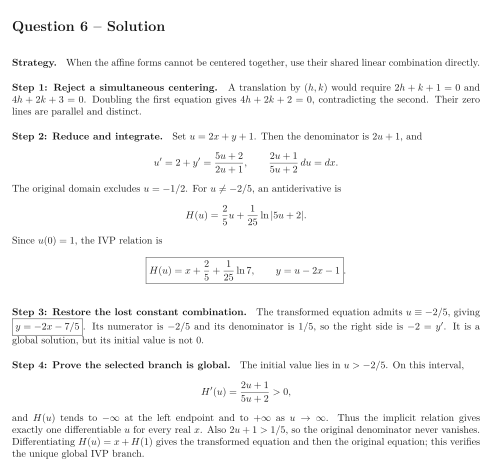
Consider an equation with parallel affine expressions: where .
Tasks
Explain why no translation of removes the constants in both numerator and denominator simultaneously.
Use to derive a separable equation, then obtain an implicit formula for the IVP.
Find the solution corresponding to a constant that would be lost during separation, and verify it in the original equation.
Prove that the selected implicit formula defines the IVP solution for every real , while remaining inside the original coefficient domain.
Show solutionHide solution
Question 6 – Solution
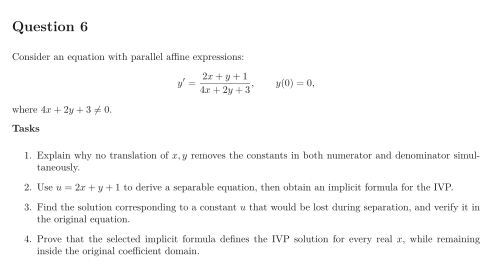
Strategy. When the affine forms cannot be centered together, use their shared linear combination directly.
Step 1: Reject a simultaneous centering. A translation by would require and . Doubling the first equation gives , contradicting the second. Their zero lines are parallel and distinct.
Step 2: Reduce and integrate. Set . Then the denominator is , and The original domain excludes . For , an antiderivative is Since , the IVP relation is
Step 3: Restore the lost constant combination. The transformed equation admits , giving . Its numerator is and its denominator is , so the right side is . It is a global solution, but its initial value is not .
Step 4: Prove the selected branch is global. The initial value lies in . On this interval, and tends to at the left endpoint and to as . Thus the implicit relation gives exactly one differentiable for every real . Also , so the original denominator never vanishes. Differentiating gives the transformed equation and then the original equation; this verifies the unique global IVP branch.