Question 3
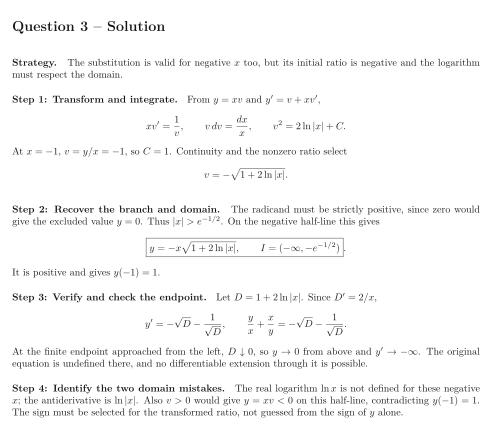
Consider an IVP on the negative half-line: with the original equation defined only when .
Tasks
Use and separate the equation, keeping the correct logarithmic absolute value.
Select both the constant and the sign of the transformed solution from the initial condition.
Recover and determine its maximal interval containing within .
Verify the equation and describe the finite endpoint. Explain why replacing by , or choosing the positive sign for , would fail here.
Show solutionHide solution
Question 3 – Solution
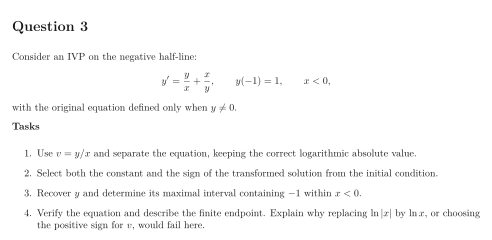
Strategy. The substitution is valid for negative too, but its initial ratio is negative and the logarithm must respect the domain.
Step 1: Transform and integrate. From and , At , , so . Continuity and the nonzero ratio select
Step 2: Recover the branch and domain. The radicand must be strictly positive, since zero would give the excluded value . Thus . On the negative half-line this gives It is positive and gives .
Step 3: Verify and check the endpoint. Let . Since , At the finite endpoint approached from the left, , so from above and . The original equation is undefined there, and no differentiable extension through it is possible.
Step 4: Identify the two domain mistakes. The real logarithm is not defined for these negative ; the antiderivative is . Also would give on this half-line, contradicting . The sign must be selected for the transformed ratio, not guessed from the sign of alone.