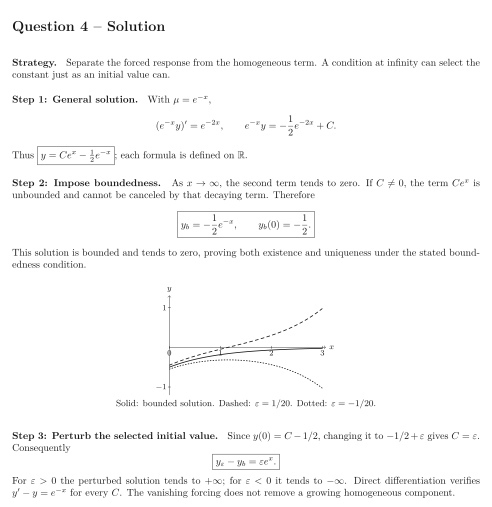
Question 4
Consider the linear equation Instead of prescribing an initial value, require that the solution remain bounded on the entire half-line .
Tasks
Find the general solution using an integrating factor.
Determine the unique bounded solution and the initial value it must have.
If that initial value is changed by a nonzero amount , find the difference from the bounded solution and describe its behavior as .
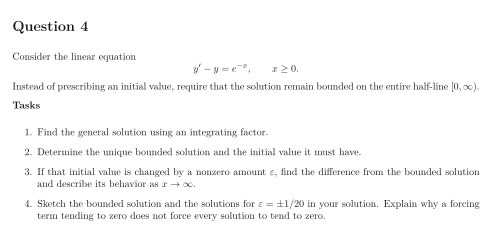
Sketch the bounded solution and the solutions for in your solution. Explain why a forcing term tending to zero does not force every solution to tend to zero.
Show solutionHide solution
Question 4 – Solution
Strategy. Separate the forced response from the homogeneous term. A condition at infinity can select the constant just as an initial value can.
Step 1: General solution. With , Thus ; each formula is defined on .
Step 2: Impose boundedness. As , the second term tends to zero. If , the term is unbounded and cannot be canceled by that decaying term. Therefore This solution is bounded and tends to zero, proving both existence and uniqueness under the stated boundedness condition.
See the diagram in the original worksheet below.
Step 3: Perturb the selected initial value. Since , changing it to gives . Consequently For the perturbed solution tends to ; for it tends to . Direct differentiation verifies for every . The vanishing forcing does not remove a growing homogeneous component.