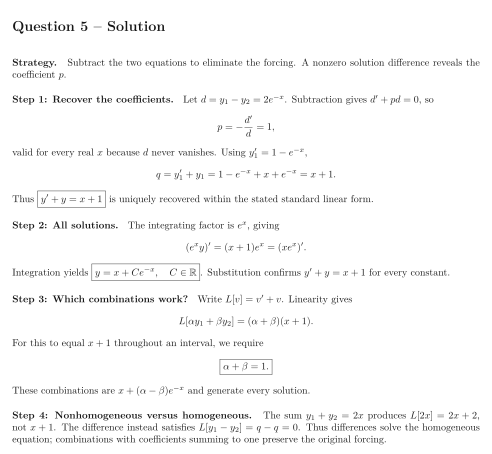
Question 5
Two functions are known to solve the same first-order equation in standard linear form, where are continuous. The functions are Tasks
Recover and from these two solutions. Explain why they are determined at every real .
Solve the recovered equation using an integrating factor to obtain all its solutions.
Determine all real constants for which is also a solution of the same nonhomogeneous equation.
Explain why arbitrary sums of solutions need not remain solutions, although the difference of two solutions always satisfies the associated homogeneous equation.
Show solutionHide solution
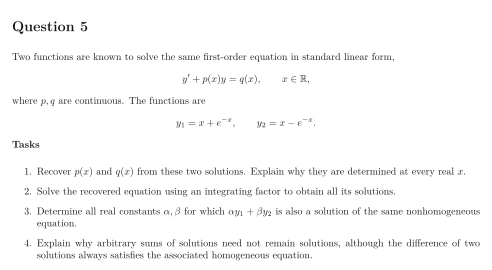
Question 5 – Solution
Strategy. Subtract the two equations to eliminate the forcing. A nonzero solution difference reveals the coefficient .
Step 1: Recover the coefficients. Let . Subtraction gives , so valid for every real because never vanishes. Using , Thus is uniquely recovered within the stated standard linear form.
Step 2: All solutions. The integrating factor is , giving Integration yields . Substitution confirms for every constant.
Step 3: Which combinations work? Write . Linearity gives For this to equal throughout an interval, we require These combinations are and generate every solution.
Step 4: Nonhomogeneous versus homogeneous. The sum produces , not . The difference instead satisfies . Thus differences solve the homogeneous equation; combinations with coefficients summing to one preserve the original forcing.