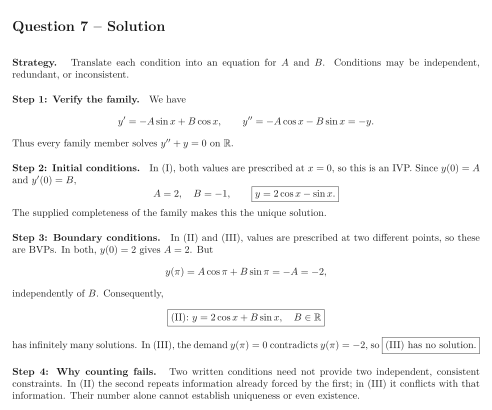
Question 7
You are given that every real solution of on has the form Consider three sets of conditions: Tasks
Verify the given family by differentiation.
Identify each problem as an initial value problem or a boundary value problem.
Determine whether each has exactly one solution, infinitely many solutions, or no solution. Give the corresponding functions when they exist.
Explain why the statement “two conditions determine a unique solution of a second-order equation” needs additional qualifications.
Show solutionHide solution
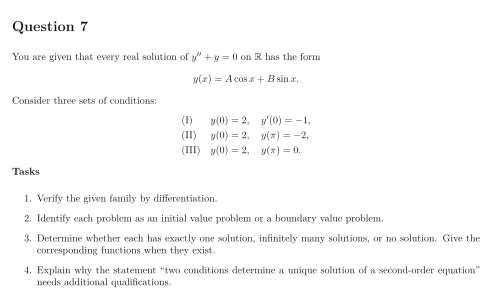
Question 7 – Solution
Strategy. Translate each condition into an equation for and . Conditions may be independent, redundant, or inconsistent.
Step 1: Verify the family. We have Thus every family member solves on .
Step 2: Initial conditions. In (I), both values are prescribed at , so this is an IVP. Since and , The supplied completeness of the family makes this the unique solution.
Step 3: Boundary conditions. In (II) and (III), values are prescribed at two different points, so these are BVPs. In both, gives . But independently of . Consequently, has infinitely many solutions. In (III), the demand contradicts , so
Step 4: Why counting fails. Two written conditions need not provide two independent, consistent constraints. In (II) the second repeats information already forced by the first; in (III) it conflicts with that information. Their number alone cannot establish uniqueness or even existence.