Question 6
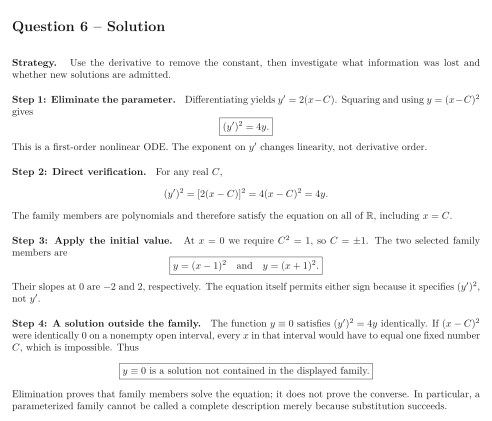
A one-parameter family of curves is Tasks
Differentiate the family and eliminate to obtain a first-order differential equation involving only and .
Verify that every family member satisfies the resulting equation on .
Find all family members satisfying , and compare their slopes at .
Test in your equation. Is it a member of the displayed family on a nonempty open interval? Explain why finding one family of solutions need not describe every solution.
Show solutionHide solution
Question 6 – Solution
Strategy. Use the derivative to remove the constant, then investigate what information was lost and whether new solutions are admitted.
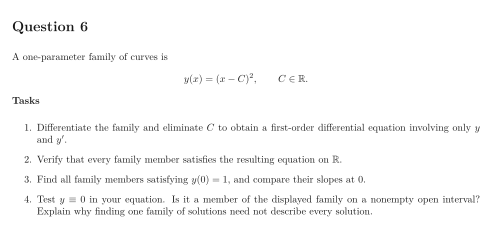
Step 1: Eliminate the parameter. Differentiating yields . Squaring and using gives This is a first-order nonlinear ODE. The exponent on changes linearity, not derivative order.
Step 2: Direct verification. For any real , The family members are polynomials and therefore satisfy the equation on all of , including .
Step 3: Apply the initial value. At we require , so . The two selected family members are Their slopes at are and , respectively. The equation itself permits either sign because it specifies , not .
Step 4: A solution outside the family. The function satisfies identically. If were identically on a nonempty open interval, every in that interval would have to equal one fixed number , which is impossible. Thus Elimination proves that family members solve the equation; it does not prove the converse. In particular, a parameterized family cannot be called a complete description merely because substitution succeeds.