Question 8
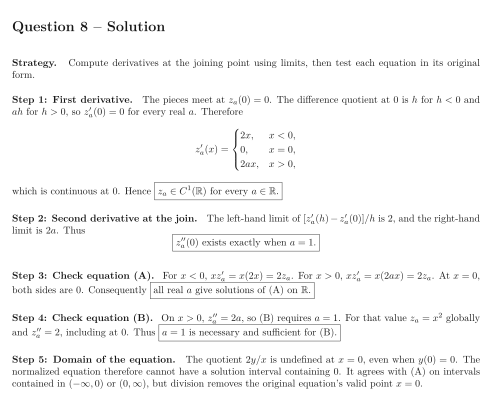
For a real parameter , define Compare the equations A classical solution must have all derivatives appearing in its equation at every point of its open interval of definition.
Tasks
Determine for which the function is on , and for which its second derivative exists at .
Determine for which it solves (A) on , checking explicitly.
Determine for which it solves (B) on .
Explain why replacing (A) by can change the permitted solution intervals, even though the two equations agree whenever .
Show solutionHide solution
Question 8 – Solution
Strategy. Compute derivatives at the joining point using limits, then test each equation in its original form.
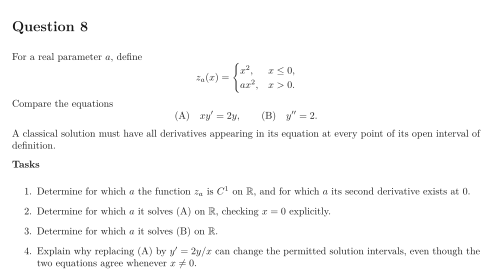
Step 1: First derivative. The pieces meet at . The difference quotient at is for and for , so for every real . Therefore which is continuous at . Hence
Step 2: Second derivative at the join. The left-hand limit of is , and the right-hand limit is . Thus
Step 3: Check equation (A). For , . For , . At , both sides are . Consequently
Step 4: Check equation (B). On , , so (B) requires . For that value globally and , including at . Thus
Step 5: Domain of the equation. The quotient is undefined at , even when . The normalized equation therefore cannot have a solution interval containing . It agrees with (A) on intervals contained in or , but division removes the original equation’s valid point .