Divergence Theorem — Question 8

PDF ↗

Question 8

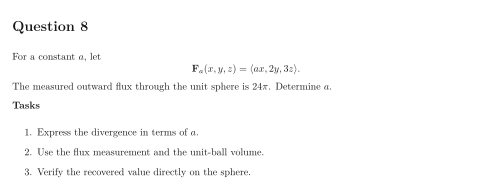
For a constant aa, let 𝑭a(x,y,z)=⟨ax,2y,3z⟩.\mathbf F_a(x,y,z)=\langle ax,2y,3z\rangle. The measured outward flux through the unit sphere is 24π24\pi. Determine aa.

Tasks

  1. Express the divergence in terms of aa.

  2. Use the flux measurement and the unit-ball volume.

  3. Verify the recovered value directly on the sphere.
Original worksheet page 1: question and worked solution for 6-6-008
Show solutionHide solution

Question 8 – Solution

Strategy. The divergence is constant, so the measured flux gives a linear equation for the unknown coefficient.

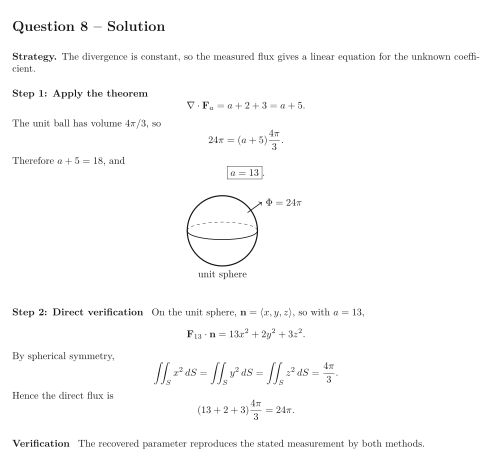
Step 1: Apply the theorem ∇⋅𝑭a=a+2+3=a+5.\nabla\cdot\mathbf F_a=a+2+3=a+5. The unit ball has volume 4π/34\pi/3, so 24π=(a+5)4π3.24\pi=(a+5)\frac{4\pi}{3}. Therefore a+5=18a+5=18, and a=13.\boxed{a=13}.

See the diagram in the original worksheet below.

Step 2: Direct verification On the unit sphere, 𝒏=⟨x,y,z⟩\mathbf n=\langle x,y,z\rangle, so with a=13a=13, 𝑭13⋅𝒏=13x2+2y2+3z2.\mathbf F_{13}\cdot\mathbf n=13x^2+2y^2+3z^2. By spherical symmetry, ∬Sx2dS=∬Sy2dS=∬Sz2dS=4π3.\iint_Sx^2\,dS=\iint_Sy^2\,dS=\iint_Sz^2\,dS=\frac{4\pi}{3}. Hence the direct flux is (13+2+3)4π3=24π.(13+2+3)\frac{4\pi}{3}=24\pi.

Verification The recovered parameter reproduces the stated measurement by both methods.
Original worksheet page 2: question and worked solution for 6-6-008

Original worksheet layout. Use Enlarge or open the PDF for a closer view.