Question 9
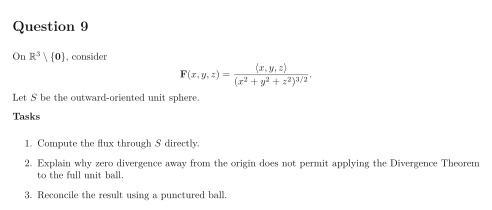
On , consider Let be the outward-oriented unit sphere.
Tasks
Compute the flux through directly.
Explain why zero divergence away from the origin does not permit applying the Divergence Theorem to the full unit ball.
Reconcile the result using a punctured ball.
Show solutionHide solution
Question 9 – Solution
Strategy. The nonzero flux is caused by a singularity inside the sphere; remove a small ball so the theorem’s hypotheses hold.
Step 1: Direct flux On the unit sphere, , so Although for , the field is undefined at the origin and is not smooth throughout the full ball.
See the diagram in the original worksheet below.
Step 2: Puncture the ball Remove the ball . On the shell , the divergence is zero, so the total outward flux is zero.
Step 3: Track both boundaries The outer flux is . On , the shell’s outward normal is , while . Thus Therefore , consistent with the theorem on the punctured region.
Verification The inner flux remains as , recording the enclosed point source rather than disappearing.
