Question 7
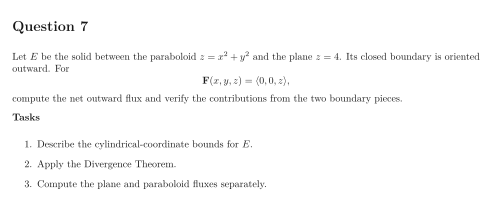
Let be the solid between the paraboloid and the plane . Its closed boundary is oriented outward. For compute the net outward flux and verify the contributions from the two boundary pieces.
Tasks
Describe the cylindrical-coordinate bounds for .
Apply the Divergence Theorem.
Compute the plane and paraboloid fluxes separately.
Show solutionHide solution
Question 7 – Solution
Strategy. The divergence equals , so the net flux is the volume; the direct check tests the downward orientation on the paraboloid.
Step 1: Bounds and volume The surfaces meet at , and Since ,
See the diagram in the original worksheet below.
Step 2: Top plane On , the outward normal is , so
Step 3: Paraboloid The solid lies above the paraboloid, so its outward vector element is downward: Thus The direct total is .
Verification The sign of the lower contribution is negative because the field points upward while the lower outward normal points downward.
