Question 8
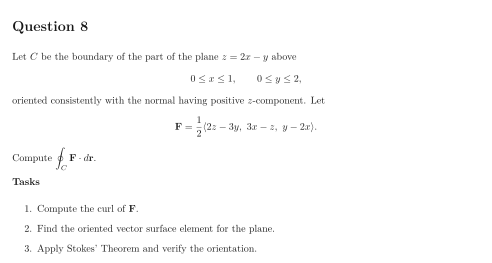
Let be the boundary of the part of the plane above oriented consistently with the normal having positive -component. Let Compute .
Tasks
Compute the curl of .
Find the oriented vector surface element for the plane.
Apply Stokes’ Theorem and verify the orientation.
Show solutionHide solution
Question 8 – Solution
Strategy. The field was chosen to have constant curl, while the plane has a constant vector area element.
Step 1: Curl Direct differentiation gives
Step 2: Surface element With , Its third component is positive, as required.
See the diagram in the original worksheet below.
Step 3: Apply Stokes The curl flux density is constant: The projected rectangle has area , so
Verification Reversing the traversal of all four edges would correspond to the negative normal and would change the value to .
