Question 7
Let be the unit circle in , counterclockwise from above. Two surfaces span it: the upper hemisphere and the paraboloid , , both oriented to induce the given direction. For compare the curl fluxes through and .
Tasks
Determine compatible orientations on both surfaces.
Evaluate one common boundary circulation or curl flux.
Explain why the two fluxes must agree.
Show solutionHide solution
Question 7 – Solution
Strategy. Use Stokes’ Theorem as a surface-independence statement: each compatible curl flux equals the same circulation around .
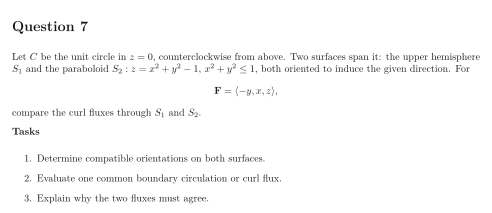
Step 1: Orient the surfaces Use the outward orientation on the upper hemisphere and the upward orientation on the paraboloid. Both induce counterclockwise motion on viewed from above.
See the diagram in the original worksheet below.
Step 2: Compute the common value Since we may use the upward unit disk spanning : Consequently,
Step 3: Explain Stokes’ Theorem ties curl flux to the oriented boundary, not to the particular spanning surface, provided the field is smooth throughout the relevant surfaces.
Verification Both surfaces project once onto the unit disk with positive vertical orientation, so integrating the vertical curl directly would also give on each.