Question 9
Let consist of the top and four side faces of the unit cube , but not the bottom face. Give the outward orientation. Its boundary is the rim of the missing bottom square. For compute using Stokes’ Theorem on the composite surface.
Tasks
Determine the induced direction of as viewed from above.
Compute the curl flux through the five faces.
Verify the result using the missing bottom square.
Show solutionHide solution
Question 9 – Solution
Strategy. The curl is vertical, so the four vertical faces contribute zero; only the top face remains.
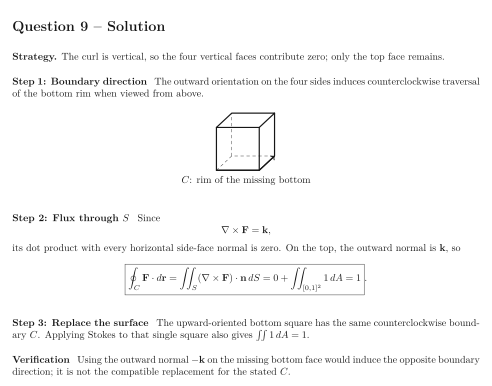
Step 1: Boundary direction The outward orientation on the four sides induces counterclockwise traversal of the bottom rim when viewed from above.
See the diagram in the original worksheet below.
Step 2: Flux through Since its dot product with every horizontal side-face normal is zero. On the top, the outward normal is , so
Step 3: Replace the surface The upward-oriented bottom square has the same counterclockwise boundary . Applying Stokes to that single square also gives .
Verification Using the outward normal on the missing bottom face would induce the opposite boundary direction; it is not the compatible replacement for the stated .