Question 4
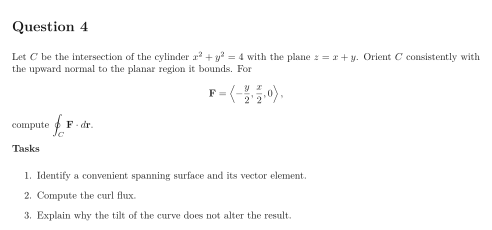
Let be the intersection of the cylinder with the plane . Orient consistently with the upward normal to the planar region it bounds. For compute .
Tasks
Identify a convenient spanning surface and its vector element.
Compute the curl flux.
Explain why the tilt of the curve does not alter the result.
Show solutionHide solution
Question 4 – Solution
Strategy. Use the planar patch over the radius- disk; its vertical vector-area component is especially simple.
Step 1: Curl and vector area We have For , the upward vector element is
See the diagram in the original worksheet below.
Step 2: Apply Stokes
Step 3: Interpret The curl is vertical, so only the vertical component of the oriented area vector matters. That component equals the area element of the horizontal projection, whose area is .
Verification Reversing the curve would force the downward normal and change the answer to .
