Question 5
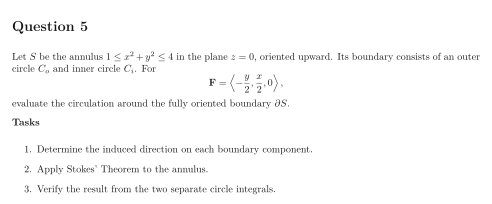
Let be the annulus in the plane , oriented upward. Its boundary consists of an outer circle and inner circle . For evaluate the circulation around the fully oriented boundary .
Tasks
Determine the induced direction on each boundary component.
Apply Stokes’ Theorem to the annulus.
Verify the result from the two separate circle integrals.
Show solutionHide solution
Question 5 – Solution
Strategy. For an upward annulus, the outer boundary is counterclockwise and the inner boundary is clockwise.
Step 1: Orient the boundary The right-hand rule gives Equivalently, traverse the outer circle counterclockwise and the inner circle clockwise.
See the diagram in the original worksheet below.
Step 2: Apply Stokes Since ,
Step 3: Check components For a counterclockwise circle of radius , Thus the outer circle contributes , while the clockwise inner circle contributes . Their sum is .
Verification Assigning both circles counterclockwise would give and violate the induced-boundary convention.
