Question 3
Let be the equator of the upper hemisphere , oriented as the boundary of the outward-oriented hemisphere. For find without parametrizing the hemisphere.
Tasks
Determine the induced direction of as viewed from above.
Replace the hemisphere by a simpler spanning surface.
Evaluate the circulation and explain why the replacement is valid.
Show solutionHide solution
Question 3 – Solution
Strategy. Stokes’ Theorem permits any smooth oriented spanning surface with the same oriented boundary; use the equatorial disk.
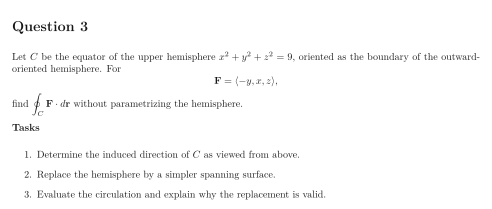
Step 1: Boundary orientation The outward normal on the upper hemisphere induces counterclockwise motion around the equator when viewed from .
See the diagram in the original worksheet below.
Step 2: Choose the disk Let be , , with upward normal. It has the same oriented boundary as the hemisphere. Since Stokes’ Theorem gives
Step 3: Explain the replacement Both the hemisphere and disk are orientable, share , and lie where has continuous derivatives. Each curl flux therefore equals the same boundary circulation.
Verification On the equator, is tangent in the counterclockwise direction and has magnitude ; multiplying by the circumference also gives .