Fundamental Theorem for Line Integrals β€” Question 8

PDF β†—

Question 8

Let f(x,y,z)=xyz+12(x2+y2+z2).f(x,y,z)=xyz+\frac 12(x^2+y^2+z^2). Evaluate ∫Cβˆ‡fβ‹…d𝒓\displaystyle\int_C\nabla f\cdot d\mathbf r for any smooth space curve from A=(1,βˆ’1,0)A=(1,-1,0) to B=(2,1,3)B=(2,1,3).

Tasks

  1. Compute f(A)f(A) and f(B)f(B) carefully.

  2. Apply the Fundamental Theorem for Line Integrals.

  3. Verify that the associated vector field is three-dimensional by computing βˆ‡f\nabla f.

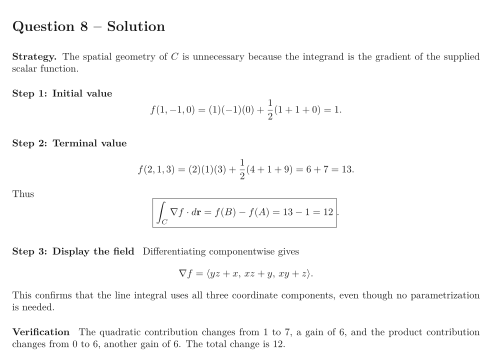
Original worksheet page 1: question and worked solution for 5-5-008
Show solutionHide solution

Question 8 – Solution

Strategy. The spatial geometry of CC is unnecessary because the integrand is the gradient of the supplied scalar function.

Step 1: Initial value f(1,βˆ’1,0)=(1)(βˆ’1)(0)+12(1+1+0)=1.f(1,-1,0)=(1)(-1)(0)+\frac 12(1+1+0)=1.

Step 2: Terminal value f(2,1,3)=(2)(1)(3)+12(4+1+9)=6+7=13.f(2,1,3)=(2)(1)(3)+\frac 12(4+1+9)=6+7=13. Thus ∫Cβˆ‡fβ‹…d𝒓=f(B)βˆ’f(A)=13βˆ’1=12.\boxed{\int_C\nabla f\cdot d\mathbf r=f(B)-f(A)=13-1=12}.

Step 3: Display the field Differentiating componentwise gives βˆ‡f=⟨yz+x,xz+y,xy+z⟩.\nabla f=\langle yz+x,\,xz+y,\,xy+z\rangle. This confirms that the line integral uses all three coordinate components, even though no parametrization is needed.

Verification The quadratic contribution changes from 11 to 77, a gain of 66, and the product contribution changes from 00 to 66, another gain of 66. The total change is 1212.

Original worksheet page 2: question and worked solution for 5-5-008

Original worksheet layout. Use Enlarge or open the PDF for a closer view.