Question 7
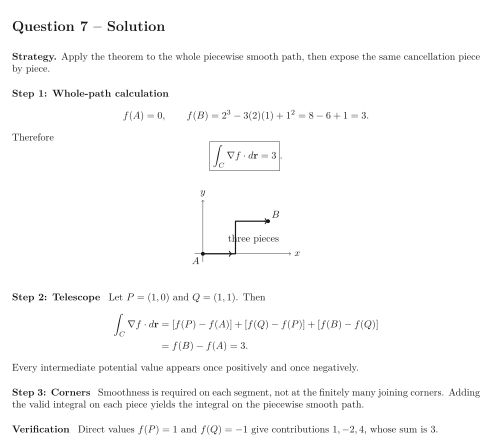
Let A piecewise smooth path travels from to , then to , and finally to .
Tasks
Evaluate using the theorem.
Show how the endpoint changes telescope across the three pieces.
Explain why the corners do not invalidate the theorem.
Show solutionHide solution
Question 7 – Solution
Strategy. Apply the theorem to the whole piecewise smooth path, then expose the same cancellation piece by piece.
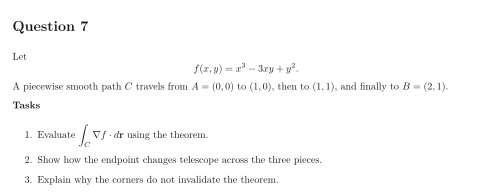
Step 1: Whole-path calculation Therefore
See the diagram in the original worksheet below.
Step 2: Telescope Let and . Then Every intermediate potential value appears once positively and once negatively.
Step 3: Corners Smoothness is required on each segment, not at the finitely many joining corners. Adding the valid integral on each piece yields the integral on the piecewise smooth path.
Verification Direct values and give contributions , whose sum is .