Fundamental Theorem for Line Integrals β€” Question 9

PDF β†—

Question 9

A force is derived from the potential energy U(x,y)=x2+2y2U(x,y)=x^2+2y^2 by 𝑭=βˆ’βˆ‡U\mathbf F=-\nabla U. A particle moves along any smooth curve from A=(2,1)A=(2,1) to B=(0,3)B=(0,3).

Tasks

  1. Compute the work W=∫C𝑭⋅d𝒓\displaystyle W=\int_C\mathbf F\cdot d\mathbf r.

  2. Relate the work to the change in potential energy.

  3. Explain the sign of the answer.

Original worksheet page 1: question and worked solution for 5-5-009
Show solutionHide solution

Question 9 – Solution

Strategy. Apply the theorem to βˆ’U-U: work by βˆ’βˆ‡U-\nabla U is the negative of the change in UU.

Step 1: Potential-energy change U(A)=22+2(12)=6,U(B)=02+2(32)=18.U(A)=2^2+2(1^2)=6, \qquad U(B)=0^2+2(3^2)=18. Therefore Ξ”U=U(B)βˆ’U(A)=12\Delta U=U(B)-U(A)=12.

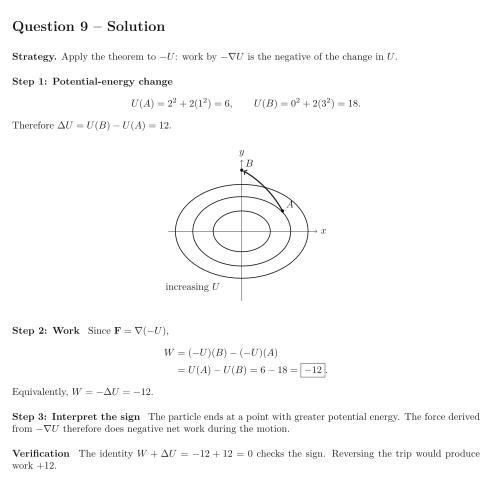
See the diagram in the original worksheet below.

Step 2: Work Since 𝑭=βˆ‡(βˆ’U)\mathbf F=\nabla(-U), W=(βˆ’U)(B)βˆ’(βˆ’U)(A)=U(A)βˆ’U(B)=6βˆ’18=βˆ’12.\begin{align*} W&=(-U)(B)-(-U)(A)\\ &=U(A)-U(B)=6-18=\boxed{-12}. \end{align*} Equivalently, W=βˆ’Ξ”U=βˆ’12W=-\Delta U=-12.

Step 3: Interpret the sign The particle ends at a point with greater potential energy. The force derived from βˆ’βˆ‡U-\nabla U therefore does negative net work during the motion.

Verification The identity W+Ξ”U=βˆ’12+12=0W+\Delta U=-12+12=0 checks the sign. Reversing the trip would produce work +12+12.

Original worksheet page 2: question and worked solution for 5-5-009

Original worksheet layout. Use Enlarge or open the PDF for a closer view.