Question 6
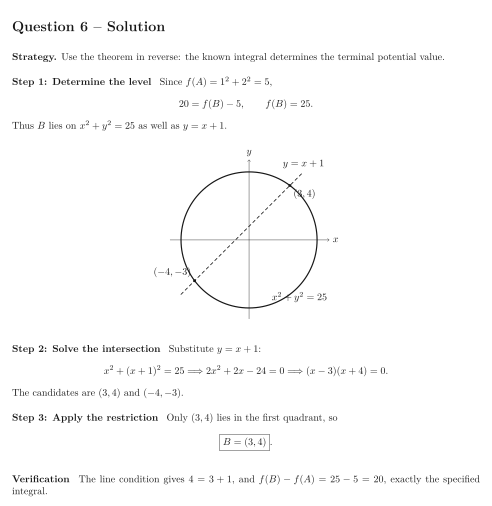
Let . A curve begins at and ends at a first-quadrant point on the line . Suppose Determine .
Tasks
Convert the work condition into a level-curve condition on .
Solve the line-circle intersection equation.
Use the quadrant restriction to select and verify the endpoint.
Show solutionHide solution
Question 6 – Solution
Strategy. Use the theorem in reverse: the known integral determines the terminal potential value.
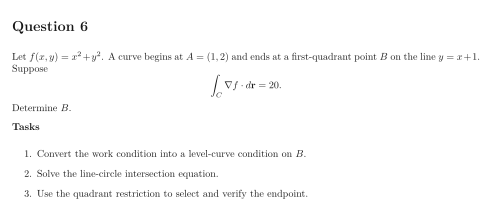
Step 1: Determine the level Since , Thus lies on as well as .
See the diagram in the original worksheet below.
Step 2: Solve the intersection Substitute : The candidates are and .
Step 3: Apply the restriction Only lies in the first quadrant, so
Verification The line condition gives , and , exactly the specified integral.