Question 2
Let . A smooth curve travels from to .
Tasks
Evaluate .
Interpret the result using level curves of .
Decide whether a different smooth path from to could change the value.
Show solutionHide solution
Question 2 – Solution
Strategy. Compare the potential values at the endpoints before doing any curve calculation.
Step 1: Endpoint values Hence
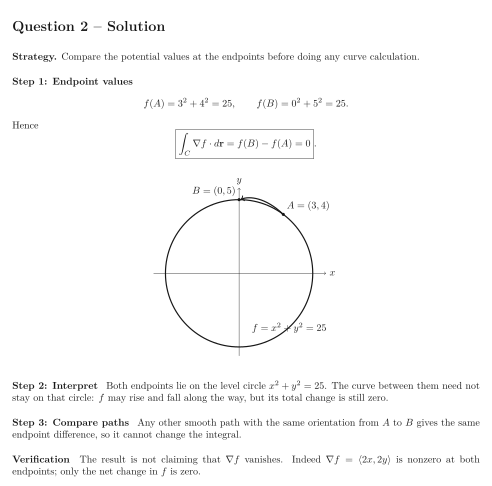
See the diagram in the original worksheet below.
Step 2: Interpret Both endpoints lie on the level circle . The curve between them need not stay on that circle: may rise and fall along the way, but its total change is still zero.
Step 3: Compare paths Any other smooth path with the same orientation from to gives the same endpoint difference, so it cannot change the integral.
Verification The result is not claiming that vanishes. Indeed is nonzero at both endpoints; only the net change in is zero.