Question 3
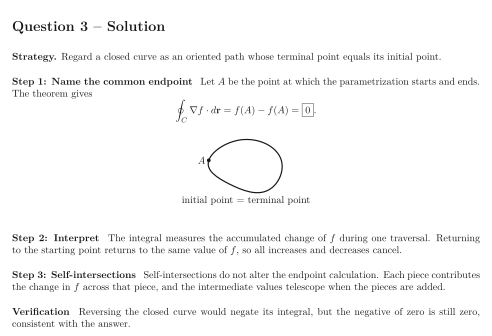
Let and let be any piecewise smooth closed curve contained in the domain of . Evaluate
Tasks
Apply the endpoint form of the theorem to the closed curve.
Explain the role of the curve’s initial and terminal points.
State whether self-intersections affect the result.
Show solutionHide solution
Question 3 – Solution
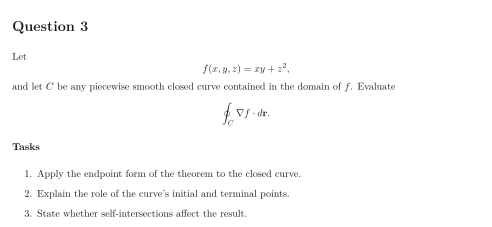
Strategy. Regard a closed curve as an oriented path whose terminal point equals its initial point.
Step 1: Name the common endpoint Let be the point at which the parametrization starts and ends. The theorem gives
See the diagram in the original worksheet below.
Step 2: Interpret The integral measures the accumulated change of during one traversal. Returning to the starting point returns to the same value of , so all increases and decreases cancel.
Step 3: Self-intersections Self-intersections do not alter the endpoint calculation. Each piece contributes the change in across that piece, and the intermediate values telescope when the pieces are added.
Verification Reversing the closed curve would negate its integral, but the negative of zero is still zero, consistent with the answer.